Thursday, September 8, 2011

The Family Tree


    It is with great sadness that I announce the passing of Silver Maple, born Acer saccharinum over a half century ago.  It was preceded in death by two partners- pin oak, Quercus palustris, and Chinese elm, Ulmus parvifolia.  It is survived by many pleasant memories shared by the home’s owner, his four children, eight grandchildren and eight great grandchildren and innumerable birds and squirrels to which it provided food and shelter.  In lieu of flowers, donations can be made to the Arbor Day Society.

    Is it wrong to have such strong emotional attachments to a tree?  The entire family felt a great loss a couple weeks ago when my father had the old silver maple removed from the back yard.  Once a strong, towering specimen, its main branches had become hollow and split over the past several years, and Dad was afraid a storm would bring its weight crashing down onto either his or the neighbor’s garage. 

    The tree has always been a part of my life and has shared over half of my father‘s nearly 90 years on this earth.  My earliest memory is of a backyard flanked on the west by the maple and on the east by the pin oak.  A little to the north and west of these was the old Chinese elm which stool vigil by the old toy trunk and which littered our pool with its ever shedding small leaves.  The elm was the first to go when I was still a small boy, but the maple and oak continued to frame our yard.  I loved the beautiful red and russet colors of the oak in fall, and the small acorns it would drop each year.  While the maple was wide and branching, the oak stood tall and straight.  However, the oak was never as healthy as it should be, and despite Dad’s best efforts, it continued to decline.  So Dad had it removed some years later.
Both the author and the trees in their infancy.  The elm is on the left with the old toy trunk by its base and the maple is to the right.

    There were many other trees that came in and out of our lives through the years.  At various times there were peach, pear and apple trees.  These dad dug up and transported from a nursery that was going out of business in his hometown of Tuscola, Illinois.  The most I remember from the peach and pear trees was the number of bees they attracted.  I was too young to ever remember a peach from one of those trees, but I do remember sampling some pears, a fruit for which I’ve never developed a taste.  

    But the apple tree remained and became one of my early childhood companions.  Being much smaller than the maple and oak, it was the first tree I was ever able to climb.  It, too, drew bees in the spring, but I had by then learned they were not a threat to me.  In late summer, it started dropping its small green fruit.  This was not a tree to produce large, sweet, red apples.  Rather it produced small green ones that never seemed to fully mature before falling and which were firm and extremely tart.  I loved nibbling on those sour apples, but thankfully never ate enough to succumb to the common intestinal woes of young boys eating too many green apples.   
My son, David, learning to climb in one of my father's fruit trees.

    Our backyard was bordered by a neighbor’s cedar privacy fence, and this became the target for my early pitching practice.  Actually, I never played ball, let alone pitch, so it might be more accurate to say it was the perfect outlet for a young boy’s pent up energy.  As I would find apples, I would step back, take aim at the fence and let them fly.  The goal was to hit with enough force to shatter the green missile into a dozen fragments.  I have no idea what my neighbor thought as he heard the repeated bangs of apples striking his fence from the opposite side, but I sure enjoyed myself.  I was less fond of the apples when fall came and the crop dropped in earnest.  That is when Dad would send me into the yard with a bucket to pick up all the fallen apples before he mowed the lawn.  The benign honey bees of spring had by now been replaced with the more threatening hornets which fed on the fallen fruit to load up on carbohydrates before winter, and although I tolerated the bees, I did not like these hornets.  I also did not like the rotting apples which had turned brown and mushy with a sickly sweet scent.  I would put on a pair of Dad’s oversized gloves and pick-up the apples as quickly as I could before dumping them on the garden to be turned under the soil later.
My son enjoying some of the last days of the tree house.  The old cedar fence was still standing.

    The apple tree was also the site of my one and only tree house.  With a sheet of plywood left over from an earlier go-cart I had built, Dad created a very simple little tree house.  He basically cut off the main leader of the tree and nailed the sheet of wood on top of that, along with some additional bracing and a couple 2 x 4‘s nailed up as railings.  There was no structure other than this simple platform, but that was all I needed.  My friends and I could still climb up and sit together on the tree house to talk and plan out our daily adventures.  One side of it was near an open area of the tree, and from this vantage point we “parachuted” out by grabbing the two by four rail, swinging out from under it and dropping to the ground.  On the other side was a lower branch that was forked.  By climbing down to this branch and walking its length, it would gradually bend and lower itself to the ground.  This we called “the elevator” and thankfully, given our small sizes, it always managed to spring back to its original position.  This tree house saw a second generation of climbers as my nieces and nephews took advantage of it in later years.  

    This was also the tree that stood in as a defensive player in backyard games of basketball.  The old basketball goal was just behind the tree, and in the early years that was not a problem due to the tree’s small size.  But as the years passed and the canopy spread, branches started reaching out to sometimes smack down a shot.  Dad kept most of these pruned, but in games of HORSE, there were always a few shots that involved squatting under the apple tree and shooting between low hanging branches.  This old family friend survived until a few years ago, when it too joined the list of departed trees.

    Another tree which earns special mention was the English walnut tree my dad planted from a walnut collected off his own father’s tree in Illinois.  He nursed the tree along, and after many years it had finally reached a respectable size and was producing its first crop of walnuts. What most intrigued me about the walnut tree was its tendency to lose all of its leaves in a single day when autumn rolled around.  Eating breakfast in the morning I would look out on a tree with a full, yellowed canopy, but when I would return from school that afternoon the tree would be totally bare and the ground hidden by a thick blanket of its compound leaves.  It was a trait I particularly liked once I became of age to help with the annual leaf raking.  Rather than repeating my job day after day, I could rake the whole batch of leaves in a single setting.  However, there was one fatal flaw with Dad’s tree and that was that he had planted it in the part of the yard in which the vegetable garden was located.  The garden had expanded through the years until a large part of it was adjacent to the walnut tree.  The problem with this arrangement was two fold.  First, walnut trees are allelopathic, which means they produce chemicals which inhibit the growth of other plants.  Thankfully, being an English walnut rather than a black walnut, this trait was less pronounced.  What proved more problematic was that the tree left most of the garden in shadow throughout the day and its roots competed for water.  Dad was faced with a difficult decision- relocate the garden or cut down the tree.  There was no other practical spot in the yard for a garden, so with a heavy heart Dad cut down the tree he had grown from his father’s tree.
The author with daughter, Rebecca, and son, David celebrating an old family chair that was moving on.  The maple tree is the backdrop.

    But the constant throughout all these other trees was the old silver maple.  While the apple tree may have been the first tree I was able to climb, the maple was the first tree of significant size that I was able to ascend and explore.  It was not an easy task in those early years.  I would have to get a running start, jump up and put my foot on the trunk for leverage and from there spring up to a large overhead branch.  Once I had grabbed the branch and was hanging freely, I could swing my feet over to the trunk and “walk” up its rough bark until I could latch them over the top of the branch.  Then with great effort and many contortions, I would work my body to the topside of the branch, and from there it was easy to move higher into the tree.  Perched in middle branches, it was my first opportunity to see the world from a bird’s perspective.  The world, and especially the tree, appeared so different from that vantage point.  I felt the urge to take wing and start exploring the loftier parts of the world.  Having finally reached a bird’s eye view of the world, I had hoped to finally explore a bird’s nest up close rather than just glancing up from the ground, but the birds were smart enough to always build in the upper branches beyond my reach.  

    The maple tree was an escape for me.  By the time I had learned to climb this tree, I felt I had outgrown the tree house, so if I wanted a loftier view of the world, it was the maple to which I turned.  There was a large branch that had the perfect angle away from the trunk and which was very stable, so this became my resting spot.  On warm afternoons I would climb to my special branch, lean back and try to nap.  I don’t think I ever actually managed to fall asleep, but I was always very comfortable and relaxed. The tree proved it could serve as a classroom or library, as well.  About the time of 5th or 6th grade, I had decided I would like to learn the Gettysburg Address, so I grabbed my Compton’s Encyclopedia, climbed to my comfy spot, and in that green cathedral with a warm summer breeze rustling the leaves, I memorized the first half of the address.  

    Around this same time, I developed aspirations of living off the land in some forested wild region.  As part of this phase, I became interested in the making of maple syrup.  Nick, the kind old gentleman who lived alone in his small trailer at the lake gave me a spile, the tube that is inserted into a tree to gather the sap, and so I set off to tap our maple.  I realized that ours was not the traditional sugar maple used to make syrup, but having tasted the sweet icicles that formed from cut branches in winter, I knew our tree’s sap contained a fair amount of sugar, as well.  So as the cold days of February gave way to the warming temps of March, I took Dad’s hand brace and drilled the appropriate-sized hole at the correct angle, and inserted the spile.  I then hung an old plastic milk jug and began collecting the rising sap.  It takes 30-40 gallons of sap to make a single gallon of syrup, and although I only managed to collect less than one gallon that spring, I still wanted to give it a try.  Dad was a good sport and decided to help me, so one evening he got out a pot and set it on the stove to begin boiling my meager collection.  It boiled and it boiled, constantly reducing in volume and increasing in sweetness, and I waited eagerly for the final product.  However, in the end, things moved sort of quickly, and we temporarily lost focus.  When we again looked at the pot, expecting to see a golden brown syrup, we saw instead a tarry puddle of black goo.  My great maple syrup experiment was a failure, and I never again tapped the old maple tree, but for me the experience was priceless.
The remains of the family maple.  The garden, firewood left from the old apple tree and the aging fireplace are seen in the background.

    Throughout the years family gatherings were often held in the shade of the old maple.  Many games of croquet were played in its shadow.  In fact, a croquet wicket, somehow left on a low hanging limb of the adjacent pin oak and forgotten, had grown into the tree and was trapped forever.  Eventually, Mom and Dad placed a porch swing there where they could sit and gently rock while keeping an eye on food cooking on the outdoor fireplace my father had built nearby.  Many a fish were fried under the canopy of the old silver maple.  Sadly, many of those fires were fueled by the remains of previous trees which had not survived the test of time as had the maple.  Eventually, Dad hung a swing from one of the trees branches, and many grandchildren and, in later years, great grandchildren took advantage of its long, gentle glide.  And just a few days before it was to be felled, Dad celebrated its life once more by putting his youngest great grandchild, Ava, on his lap and going for a final swing.  It was two big kids enjoying themselves in under the tree that had seen so much life.  
Dad with his great granddaughter Ava playing together one last time on the swing.  85 years may separate them in age, but they are both still kids at heart.

    But now there is only a stump.  It measures 46 inches in diameter, and a second slab is laid at its base.  Its surface traces the story of our lives, each ring giving testament to another year of our family history.  If I counted back, I could see the outline of the small sapling that stood when I took my first steps.  Counting further, I could find the year the tree withstood the great blizzard of ’78.  And just a couple more rings out I would again see the tree as it was when I left home to attend college, never again to climb its branches.   Those branches no longer spread wide to embrace our family as they did for half a century.  No, a great friend is gone, but it is not forgotten nor is it lost to the youngest of our family.  While they can no longer scale its heights, my father had the tree cut flat and smooth a couple feet off the ground.  It is now meant to be a stage for the great grandchildren, a place where they too can dream of their futures much as I did laying back on my perch many years ago.  I am happy that he did this, because this tree has been too much a part of our history to just vanish from sight.  Our old friend sits transformed, but its foundation remains, and it is still very much a part of our lives.

Wednesday, August 31, 2011

Twilight

I have strolled out onto my deck this evening to read a book.  It is twilight, the period when time is suspended between day and night.  I must admit that I am equally enamored with both sunrise and sunset, and to choose a favorite would be like picking a favorite child.  I love watching the world awaken at first light, but I am equally intrigued when the western sky starts glowing red and the day’s activities wind down.   In the grand enterprise of life, this is the shift change between day’s animals and the creatures of the night.  For me it is my time to relax and unwind and enjoy the cool, still air of evening.

Tonight I emerge just as the sun was dipping below the trees.  I have watched the leaves change from a golden green, back-lit by the angled rays of the setting sun, to now just silhouettes against the evening sky.  It is an active time as the birds make their final scramble for an evening meal before settling down to roost.  I sit back in my chair and watch a nighthawk make a low pass.  Above it a chimney swift beats the air in its pursuit of high-flying food.  To my right a small flycatcher is silhouetted against the top of a cherry tree.  Again and again it makes a mad dash from its perch to snag small insects then quickly returns to await the next hapless bug.

In the lilac bush a Carolina wren has hopped up and is clinging sideways to a branch; its raised tail and quick movements give it a cocky appearance.  However, tonight it is quickly scolded by a chattering hummingbird passing overhead on its way to the feeder.  The hummer takes a quick drink then rises to a low branch on another cherry tree where it can keep vigil over its food supply.  I’ve learned that hummingbirds are among the most selfish and protective of all the birds that visit my yard.  It would seem they exert more energy protecting their food source than they could possible derive from feeding there, but they are determined, if nothing else.

The finches are feeding actively and I can hear the cardinals in the nearby woods giving their “chip” call.  The wings of the mourning doves whistle as one by one they rise from their resting spots on the ground.  A pileated woodpecker sings out with its laughing call as it searches one of the dead trees in my woods for hidden ants or larvae.   Overhead small flocks of birds pass hurriedly to their evening roosts.  One flock stands out, and that is a large muster of crows.  I have not before noticed an evening flock pass by, but I’m sure it is a common occurrence.  I think of Shakespeare’s words, “Light thickens, and the crow makes wing to the rooky wood.”  Their hulking figures lend an eerie quality to the evening.

The light is growing fainter and now a large dragon fly patrols the area near the top of my trees.  I’ve yet to see it, but soon the brown bat will make its appearance.  The mosquitoes are feasting on my ankles, so the bat is sure to have a good meal.

Now the sounds are beginning to change.  Bird calls have become less frequent, but a cicada has started with its raspy buzz.  From a dozen different spots surrounding me in the woods, frogs have begun their evening trills.  A cricket is evidently inspired and joins in this nacht musik.  From across the creek, dogs are barking and baying from farms and backyards.  First it was a lone dog off to my left, but soon a group of dogs with deep voices like hounds added its comments.  The call was carried off to my right as a smaller dog started barking, as well.  Just as quickly as they started, the dogs quickly lose interest and are silent once more.

The air is now noticeably cooler.  For so much of the summer it has been too hot and humid to sit out in the evening.  Even darkness brought no relief, but the sunlight now strikes the earth more obliquely and its heat is much less intense.  Our days are still quite warm, but mornings and evenings are very comfortable and invite open windows.  I’ve moved indoors to escape the mosquitoes, but I can still hear the evening sounds.  The frogs and crickets are now in full voice, and the birds are silent.  The nighthawk just made a final pass before disappearing into the darkening sky.  It is time to bring in the bird feeders before the raccoons make their evening scavenging raids from the nearby woods.  They are always quick to take advantage of a free meal, and all feeders must be in before nightfall.  They usually come when it is too dark for me to see them, but their fighting and squabbling usually alert me to their presence.  The sound of fighting raccoons can be quite unsettling on a dark night, but tonight it is just the frogs and crickets.

Like the birds, I too have come to the end of my daily activities.  Tomorrow I will rise and sit in my rocker on the porch and watch the sun return in the eastern sky.  As the rays of sun warm me, I will resume my book, listen to the shift change once more and enjoy the greeting calls of the morning birds.  “And God called the light day, and the darkness He called night.  And there was evening and there was morning, one day.”  And like Him, I see that it is good.

Wednesday, August 17, 2011

Saying Goodbye


Ruby Lee Hayden Fifer 1922-2010
            The call had come about mid-afternoon.  “I think this is it.  Her breathing is really labored, and it just feels different this time.”  It was a call I had been dreading yet expecting for the past several days.  I cleared the rest of my afternoon appointments then hopped in the car for the long drive to the east side of Indianapolis.   On the drive over I contemplated how I would handle the coming hours.  I do not deal well with death in any circumstance and, with the exception of grandparents or aunts and uncles, had never lost anyone close to me.  And I certainly had never been with anyone as they passed.  Yet here I was heading off to spend what I knew would be the last moments I would ever have with my mother.
The family on Easter morning (minus my oldest sister)
            I thought back to those early years when it was just her and I alone together for much of the day.  I was the last of four children and lagged behind my closest sibling by five years.  While my brother likes to joke that I was an accident, my mother had explained to me that with my sister finally heading off to school, she knew she would be lonely.  So it was decided they would have just one more child so my mother could enjoy doing what she loved so much, being a mother, just a little bit longer.   And so Mom and I had spent my first five years keeping each other company during the day. 
Mom, me and my older brother who claimed I was an oops.
Helping Mom into the car
Snapshots of those early days flashed through my memory as I robotically drove the route to the nursing home that had become so familiar.  I could see myself as a small boy sitting on the floor building houses with dominoes on the cutting board from the kitchen while Mom cleaned house around me.  I recalled all the trips we took together, whether it was to the grocery store, the butcher in Zionsville, the doctor or the beauty parlor.  There was a period where she didn’t have to go to the beauty parlor since her beautician lived only a few houses down.  Esther would come over and wash and set Mom’s hair, and I would lie on the floor and sleep to the hum of the big hair dryer.  And I could feel the softness of her lap as my thoughts drifted back to being a young, bored boy at church, lying on the pew with her lap as my pillow, her hand quieting my tapping foot.  She was young again in these visions and all seemed right with the world for that brief moment, but then traffic jolted me back to reality.
The happy early days.  Mom and Dad with my older sister and brother.
            I made good time and hurried into the nursing home, my hand trembling as I signed the guest log one last time.  The atmosphere in her room was so different that evening.  The first thing I noticed, which I had not seen before, was the sticker by her door which indicated this was a hospice room.  The curtain separating Mom from Beatrice, her “roommate,” was drawn and the lights were off.  Bea was seldom in the room when I visited Mom, and it was usually well lit.  The family was gathered around her bed, and I could see what they had meant about her breathing being different.  The breaths were harsh and deep, and she seemed to fight for every one of them, even with the supplemental oxygen being delivered to her nasally.  As the hospice literature had warned us, the thick secretions in her chest vibrated with each breath creating the proverbial “death rattle.”   My sister explained that her breathing had been worse earlier, but they had given her medication which had calmed it considerably.    
            In the background, my siblings were playing country music, which my mother loved so much.    She also enjoyed big band music, but most of the time, it was a country music album she slipped onto the turntable.  On rare occasions while working around the house, Mom would sometimes sing along.  I thought she was a good singer, and something in her voice has always reminded me of Ella Fitzgerald, although no one has ever said they agree with me on that.  Even now I can listen to an old Ella song, and I hear Mom singing to me.   On this evening, Marty Robbins was singing from the CD player in the room, and I could remember the time we watched him perform at the WIRE picnic many years before.  WIRE was the local country music station, and each year it sponsored a free, all-day concert with both local musicians and big name stars.  Mom would prepare a big batch of fried chicken, we would load the cooler with drinks and head off for a hot but enjoyable day in the sun, listening to some really top quality country music.  However, tonight the music brought me no joy.
The new parents.  Mom and Dad showing off my sister, Dianna.


            In the room with me were my siblings, my father and some of Mom’s granddaughters and great granddaughters.  Family was everything to Mom.  She had devoted her life to being a loving wife, mother, grandmother and eventually great grandmother.    By the time I had come along, Mom definitely had the routine down, but I look back on early photos of her as a new Mom, and I can see some of the exhaustion in her eyes.  A strict and immaculate house cleaner, she balanced caring for her home with caring for us, and she didn’t scrimp on either.  Up before the crack of dawn, Mom would indulge herself with a little time in her easy chair with a cup of coffee, but then it would be work, work, work from that moment on.  So many mornings I snuggled in next to Mom, joined by our three poodles.  The warmth of my mother, the smell of her coffee and the softness of the poodles was a great way to start the day.  Breakfast was not a meal to be taken lightly, and although I had many years of cereal, I also enjoyed many years of bacon, eggs, hash browns and toast.  There were also pancakes, French toast and oatmeal.  A very special treat for us was when she made cinnamon toast in the little toaster oven that otherwise remained hidden in the cabinet above the refrigerator.  She didn’t enjoy making it, I suspect it made a mess that was hard to clean, but I have never had any cinnamon toast rival what she produced. 
A tired young mother giving my brother, Jerry a bath.
            When we were little, I’m sure this time of day was bath time.  Mom would pull out the little yellow, plastic tub and fill it with warm water and set it on the table.  Then she would plop us in and give us a good scrubbing.  I don’t know how vigorous she was when we were babies, but years later, after a weekend of romping in the woods, Mom would lay us down on the kitchen cabinet, head resting over the sink and wash our hair.  Of course she wanted to get us clean, but her larger goal was to detect any hidden ticks, and in doing so her aggressive scrubbing took with it a part of our scalps. 
My morning bath.  Note the laundry already drying on the line outside.
            She was equally aggressive at cleaning the house.  Even though my mother was born to simple Kentucky farmers in the 1920’s, she was taught early the importance of a clean house.  In her memoirs, written as an assignment her freshman year in high school, Mom wrote about an incident when she was a small girl and her cousin had made the house dirty while they were playing.  My mother was so angry, she locked her cousin out of the house, and that attitude about a clean house stayed with her until the day her health forced her to leave her home and enter a nursing facility.  As toddlers, we were allowed to play while she cleaned, but as we got older, we were all assigned jobs to assist her.  I collected trash from all the rooms and would burn it in the barrel behind our house.  My sister and I took turns carrying all the rugs out onto the front porch to shake the dirt out of them.  Our beds were to be made, our floors swept and our furniture dusted.  One day a week, she would have us remove everything from the dressers and tables and polish the furniture.   Mom had built up some very strong arm muscles in her right arm from scrubbing and pushing a sweeper around so many years, and neither my brother nor I could ever beat her at arm wrestling.
Mom, always at home in the kitchen
            At noon, Mom always made sure we had a good lunch.  In the early years we walked to school in the morning, but Mom brought us home at noon for lunchtime, then it was back to school for the rest of the day.  This was the time in which Mom took her one work break.  You never caught my mother resting during the day, except for her hour of the soap opera “As the World Turns.”  Then it was back to work doing laundry and preparing dinner.  Mom was the best cook I’ve ever known, although my sister is now walking closely in her footsteps.   From her everyday meals to her cakes and cream pies to her Christmas fudge, no one could top her skill in the kitchen.  After dinner, she would wash the dishes then settle down to read the paper and enjoy some evening television.   It was now that time of day, and I would have given anything to go back 40 years and be snuggled between my parents with the big yellow bowl of popcorn between us, once again watching an old western or variety show.
Nighttime prayers with my sister, Dianna
The dementia showing in Mom's face at their 60th anniversary
            But tonight there was no television, no couch and no popcorn.  There were only the labored breaths of my mother and the tears of my family.   Mom had been in the nursing home a little over a year.  Dementia had robbed her of her ability to care for herself, and that combined with the fact that she was pretty much a physical invalid became more than my 87 year old father could handle alone.   Harder than letting her go that evening was the morning we took her to the nursing home.  Though mentally dazed and confused, she still knew enough to know what a nursing home was and that she wanted nothing to do with it.  Dad had tried to explain to her how he could not take care of her like he wanted, and that he needed surgery on his eyes and would unable to care for her at all for a while.  He was trying to soften the blow, but she was still unaware that she was heading to a nursing facility.  I arrived that morning to see Mom in her rocking chair with her morning cup of coffee.  She looked at me and gave me a big smile and told me hello.  I tried to keep up a happy front, but all I could think was how this was her last morning in the house in which she had spent half a century.  When we finally arrived at the nursing home, she understood what was happening and had to be pried from the car.  She was hurt and angry, and I felt like we all had betrayed her.  Her jaw was clenched, she refused to talk or make eye contact until about a half hour later when finally she let me take her hand and hold it.  I knew the storm had passed, but it scarcely made the moment any easier.  In these final months Mom had accepted her situation and would sometimes even ask to return when Dad would bring her home for her weekly hair appointment and overnight stay.
Being a Mom is an exhausting job.
            It was fortuitous that Dad had placed Mom when he did, because a few months later he was stricken with Guillain-Barre Syndrome which left him paralyzed and weak for several months.  He could not even sit up on his own, let alone care for my mother.  Yet a strange and wonderful thing happened during my father’s illness and convalescence.  At first we withheld the news from Mom until we knew for sure what was happening with Dad, saying instead that he wasn’t feeling good and was at home resting.  When we knew he was not going to be on his feet any time soon, we finally had to come clean.   When she learned the real situation, she wanted to see him.  My wonderful sister got her dressed, loaded her into the car and took her to the hospital.  We wheeled her up Dad’s bed, and they took each other’s hands and without words they sat and comforted each other for the better part of an hour.  Mom became so focused on Dad, that for a while the cloud lifted, and she showed clarity of mind she had not shown for many months.  For that brief period, we had our mother back as she worried who would pay the bills, clean the house and care for our father.  However, all good things must come to an end, and so it was with Mom as she gradually slipped back into the fog of dementia.
Mom enjoying one of her first grandbabies.
            Mom had one more moment of clarity that we all will cherish forever.  It was her final birthday, and Dad had brought her home for a couple days.  Mom usually didn’t know what day it was, and we didn’t believe she would even comprehend that it was her birthday.  Yet she was “with it” that day and knew exactly what it was and that she was turning 85.  She enjoyed opening her gifts and eating birthday cake.  Earlier that day I had called my father to ask him to wish Mom a happy birthday since I was unable to make it over.  As the line rang on the other end, I was totally shocked to hear my mother answer the phone. She could scarcely reach it, and we had not had a meaningful conversation over the phone for almost a year.  Yet here she was understanding every word I said and answering me with clear, meaningful sentences.  It was the greatest gift my mother ever gave me, and the last good conversation we ever had.
Playing around in happier times.  Mom, Sheila and me.
            We were blessed in that until the last week of her life, Mom knew us all and could still call us by name.  My brother had the unfortunate luck of being the one that my mother would sometimes confuse with her late cousin, Dewey.  Although Mom and Dewey had grown up together and had once been very close, they must have had a tumultuous relationship because whenever my brother became “Dewey,” he was the victim of her wrath.  Her demeanor was totally different when she thought he was her cousin, and she would boss him about and quickly become agitated with him.  However, as soon as she again recognized him as her son, the love was back. 
Mom never lost the thrill of seeing a new grandchild.
            A few weeks after Mom’s birthday, she developed a cough.  The doctor immediately started treating her for a respiratory infection, but several days later Mom just seemed to shut down.  She no longer interacted; she only stared ahead or looked through you.  She quit eating and no longer got out of bed to sit in her chair.  We knew as a family that she was leaving us, and so the wait began.  Hospice was contacted and we were educated on what to expect over the following days. 
            And that is how my family came to be gathered in that crowded, dark room one year ago today.  We were there to say goodbye and to stand by the person who had always stood with us through every pain, travail or success we had ever experienced.  We took turns holding Mom’s hands, wiping her mouth, kissing her head, rubbing her feet and assuring her that she could finally quit fighting.  She couldn’t communicate, but we could still see her struggling as she had done for so long.  She never let her physical and mental frailties defeat her, and her stern countenance told me she still did not want to give up.  Then suddenly her breathing again changed, periodically halting as she became agonal, so my sister flagged down the nurse.  The attendant gave my mother another dose of medication intended to ease her breathing, but instead of the desired effect it choked her and she started coughing and gagging.  She opened her eyes, looked at me with a frightened and pleading look, and then it was over.  The breathing stopped and the stare became vacant.  That look has haunted me ever since.  She looked so scared, but I think she just didn’t want to give up a fight she realized she was losing.  Mom never wanted to stop being a mother and wife, and in that instant she knew it was over.   
The entire family including grandchildren and great grandchildren.
            It was such a surreal moment.  I knew I had just said goodbye forever to my mother, and the pain of that cut me to the core.  Yet at the same time, I was so happy that Mom’s battle was finally over.  For the first time in so many years, she was at peace.  There was no more pain and no more fighting just to have a complete thought or answer a simple question.  That is what has gotten me through this past year.  People try to comfort you by reminding you that your loved one “is in a better place,” and I now understand the power of that statement.  Even now the tears still flow, but my heart is content because I know my mother is finally getting the much deserved rest she earned through a lifetime of hard work and self-sacrifice.    We were so blessed to have her in our lives, and her presence and love is still felt every single day.
                                     We love you, Mom!

Saturday, August 6, 2011

Beating the Heat

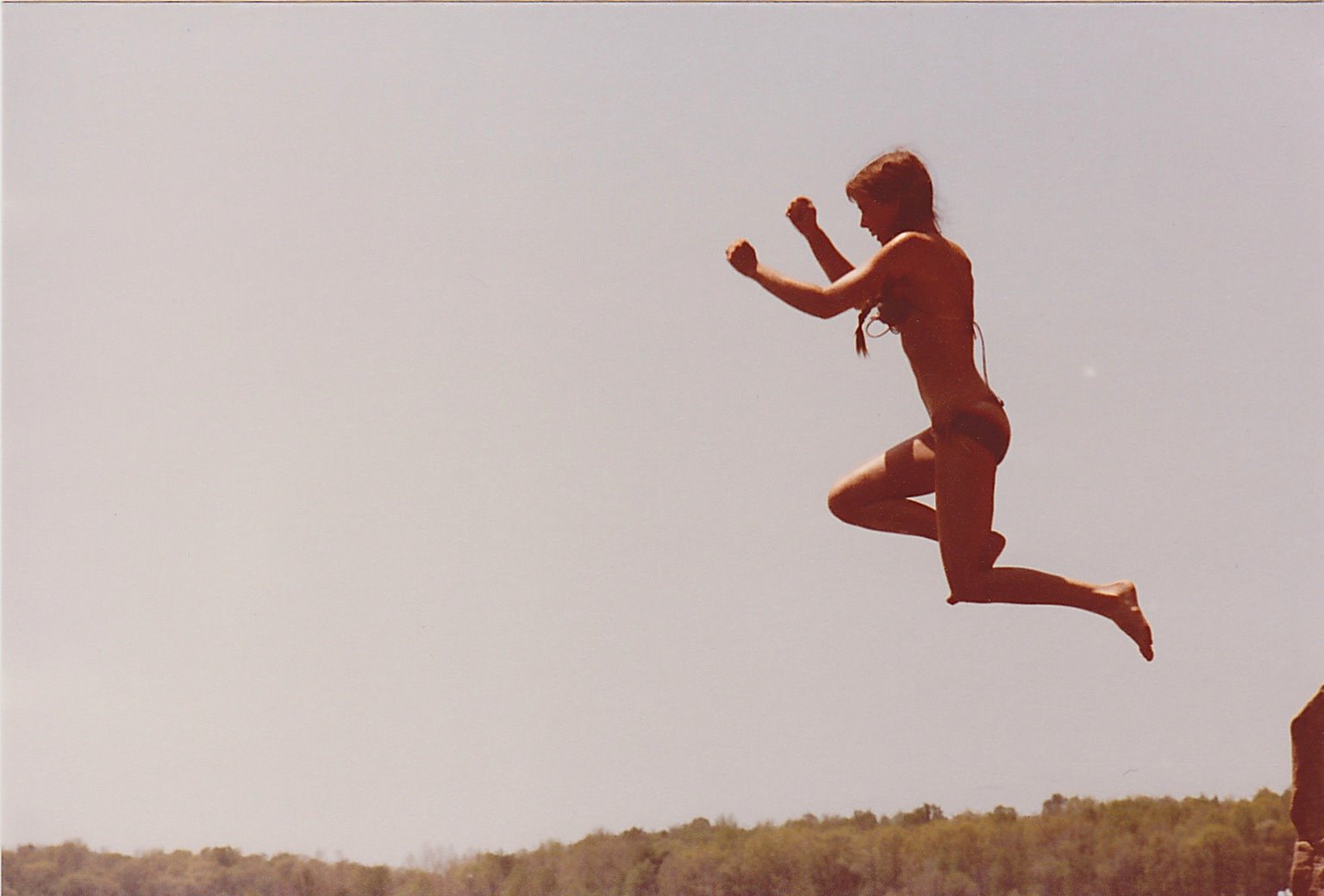
My niece, Karri, cooling off in the lake
            It seems the weather forecasters are running out of adjectives for this summer’s heat.  Sultry, tropical, muggy, steamy, oppressive, record breaking, dangerous and even deadly have been used to describe what most of the US has experienced for the past month.  Regardless of the word du jour, all I know is that it has been very hot, very dry and I’ve been very uncomfortable.  It seems that each year that passes and each inch I add to my waist makes me less tolerant of heat.  I cannot even step outside to water the hanging baskets without soaking my shirt in sweat.
            It hasn’t always been like this for me.  As a child, I grew up in a home without air conditioning, and yet I don’t remember ever feeling overwhelmed by heat.  Perhaps it is just selective memory, but there is not a single instance in my youth in which I recall losing sleep or refusing to go outside because of high temperatures.  That is not to say we didn’t do things to beat the heat.
            As I’ve already stated, we did not have air conditioning.  What we did have was a large window fan that sat in my sisters’ bedroom window.  All the other windows would be opened and the fan turned on creating a natural air flow through the house.  In addition, a small, noisy oscillating fan sat on my dresser to cool my brother and me at night.  The white noise from that old fan was the lullaby that sang me to sleep each evening.  With the fan humming and slowly rotating back and forth on one side of me, and the summer breezes drifting in from my window on the opposite side, moving the curtains and causing the blinds to be sucked in and out of the screened window, it was some of the best sleeping I ever experienced in my life.
            I spent most of my summer playing outside.  In those days you spent the warm months shirtless and shoeless, and I was certainly no exception.  And I could always stir up a breeze by swinging, a pastime about which I’ve written in detail before, or riding my bike briskly up and down the street. 
Author ready for the pool
            Each summer I looked forward to playing in the small swimming pool that my parents would erect in the backyard.  It was nothing large, maybe only two feet deep with aluminum sides and a vinyl lining that was snapped to the edge with curved clips.  There was a circular patch in the back of the yard where grass no longer grew which Dad would cover with sand to protect the liner.  Then he would roll out the sides of the pool, and he and mom would position the liner.  That’s when the fun began as the hose was dragged back to the pool and the water turned on.  My sister and I were so anxious to swim that we hopped in the pool when the water was only ankle deep and icy cold.
            There is not much one can do in such a small pool, but that did not diminish our enjoyment.  I liked to spend much of my time underwater, circling the outside edge or perhaps pretending I was a frogman on a secret mission for the navy.  My sister was more content to sun herself on an air mattress.  However, the most popular thing to do when friends joined us was to create a whirlpool where everyone began moving in the same direction around the perimeter of the pool until the water followed suit and a current was created.  At that point, we had one of two options.  Sometimes we would plop down and float letting the water carry us along, and at other times, we would do an about face and begin walking “upstream” against the current until it switched directions.
            I can remember how my mom, with her usual neat and tidy disposition, kept a dishpan of water by the pool so we would first rinse our feet to remove the grass that would invariably stick to them after Dad mowed.  Still, blades of grass made their way into the pool along with leaves from the old elm tree that once shaded our backyard.  That’s when my mother would roll up her pant legs, grab an old piece of window screening and step into the pool to strain out all the debris and bugs.  And whenever we would start feeling the slick, slime layer that inevitably forms in a pool, Mom would bring out the jug of bleach and treat the water. 
In between dips in the water, we would crunch on ice cubes Mom had made from Kool-Aid, or if it were a special occasion she and I would churn homemade ice cream down in the basement.  Mom would freeze water in buckets and then she and I chip away with ice picks creating enough small chunks to toss into the ice cream freezer.
The sister pond to our swimming hole
            This was also the time we made our weekly visits to Raccoon Lake, and water was an escape from the heat there as well.  The gravel lane leading to the trailer court where we lived, wound through the woods and beside two ponds.  One of these ponds was left natural and was for fishing; however, the first pond was groomed by the camp owner into a swimming hole.  Vegetation had been cleared from its edges, sand brought in to create a narrow beach and a floating dock with a diving board was anchored in the deeper water.  Spring fed, the water was always cold regardless of how warm the weather.  However, even though it may have been spring fed, the water was not clear but rather a murky green. Upon stepping into the water, one’s feet would sink into the soft claylike ooze that was the natural lining of the pond.
 When first arriving, we would inspect the water’s edge for snakes, even though we were blessed to live in a region without poisonous forms.  Large, black bullfrog tadpoles lazed in the shallows but were always skittish and scurried away as we approached, as did the small adult frogs that would suddenly leap into the water ahead of us.  On the surface of the pond, water beetles would scurry in circular patterns while water striders glided across the surface, looking like spiders walking on water.  Those bugs did not bother us, but the deer flies that constantly dive-bombed us and bit us painfully on the shoulders did cause their fair share of consternation.  We would repeatedly dive underwater or splash a wall of water in their direction, but the flies were never to be deterred.
Water strider photo compliments of bigfoto.com
            The camp owner had a pair of daughters who often joined us at the pond.  I had a boyhood crush on Susie, the younger of the two, and as young boys are known to do, I showed my affection by being a brat.  My usual goal when she was sun bathing on a raft was to slip underwater, quietly emerge behind her and uncork her air mattress.  She took this in good humor and occasionally did likewise to me, but alas I never won her affection.
Some of the sandstone ledges around the lake
            The lake held other water-related activities.  As we matured, we moved from swimming in the pond to swimming in the lake itself.  My father located an old tractor inner tube that could easily sit three or four people or allow a soul person to stretch out for a lazy float.  By that time, my sister was married and she, her husband and I would take turns attempting backflips off the edge of the tube.  We would also sometimes boat to the idle zone in north half of the lake where the shoreline changed from sloping ground to sandstone walls and ledges.  One ledge in particular jutted out over deep water, creating the perfect diving platform.  It was a little tiring diving off the ledge, swimming around to a low point and again climbing your way back up, but it was well worth the effort.
My sister, Sheila, diving from the ledge
            Time passed and I moved onto water skiing.  No one had ever successfully skied in my family, so it became the blind leading the blind when it was time for my parents to try to teach me.  One sunny summer day we set out to give it a try.  Dad would push the throttle forward and I would drag through the water until I managed a half standing position, only to have my feet shoot out in front of me, sending me crashing into the water.  This was repeated over and over again for well past an hour, and I never did surface long enough to call it a successful run.  I particularly remember one speed boat pulling what appeared to be a five year old skier making several passes during this ordeal.  The boat’s driver became so exasperated with my efforts that he pulled up to our boat and told my father we would like to give me a try.  He assured Dad he could get me up and skiing.  Perhaps if he had offered earlier he would have been successful, but I was too exhausted by that point.  I remember my father having to pull me into the boat and I could not even stand due to my over-taxed leg muscles.  However, when we tried again the following morning, I was successful and never looked back, eventually even learning to slalom.  My parents would take me out early in the morning when the lake was quiet and smooth as glass, and I would ski until I had worked up a good appetite.  There is no better way to prepare for breakfast on a hot summer morning.
The author out for an early morning water skiing trip
I think I was just having so much fun in those early days that I never took the time to feel the heat.  Today there is no pool in the yard, no lake in which to play, and it has been years since I strapped on skis.  Rather than swinging or biking, I find myself mowing, and trust me, I don’t move fast enough to stir a breeze with that.  Instead of looking for fun in the sun, I’m preoccupied with adult concerns such as how the lawn is turning brown and weeds are thriving in this hot dry weather.  And with the added insulation of many extra pounds, I frequently must have a fan on me even though my house is air-conditioned. Yet I know in just a few short months, I’ll be lamenting the cold and wishing it were warm again.  For now, I will just celebrate the fact that today, for the first time in three weeks, the temperature did not hit the 90’s.  Maybe I’ll go out and play in the sprinkler.

Monday, July 4, 2011

Traditions

Rebecca many years ago
As a child, the 4th of July was all about the nighttime celebration of fireworks.  I believe I have before written of watching them from the street corner when I was a boy.  At that time, in the 1960’s, the neighborhood was in its infancy.  The entire area had been farmland just years before, so the trees were still relatively short.  This afforded a much greater view of the sky than is now possible so many decades later.  Not far from us was a shopping mall called Eastgate.  At that time, a shopping mall was a new invention, so Eastgate did various things to draw attention to itself.  Occasionally, a circus would set up on the grounds, the elephants doing the heavy lifting.  But on the evening of July 4th each year, it was their pyrotechnic display that captured attention.  This show was quite visible from our nearby street corner, and so that evening at dusk the children of the neighborhood would start hauling lawn chairs and blankets and set up on the sidewalk next to our neighbor’s spreading juniper bush.  That neighbor, Mrs. Walker, would usually make popcorn or some other snack for us, and sometimes Gilbert, the rough and tumble boy from the other end of the street would come by and tease us with firecrackers tossed in the air in our direction.  Finally, when the sky was completely dark, the fireworks began to rise in the southeastern sky.  I’m sure they were quite simple and boring by today’s standards, but to a group of kids in the 60’s, they were magical.  We would sit transfixed and ooh and ahh and try to guess the next color until the grand finale marked the end of the show.  Then my sister and I would bid our goodbyes and make our way back down the street to our own house, where my parents would be waiting on the front porch.  That is when we finally got to play with the sparklers my mother had purchased.  I can still remember the popping and fizzing sound they made and the smell they gave off as we swung them round to trace figures in the air.   No matter how many times my mother would caution me, I would invariably grab a still hot, used sparkler and burn my hand, but it was never anything serious.  It was simple, but it was oh so much fun for me, and I counted down the days until July 4th would again roll around.

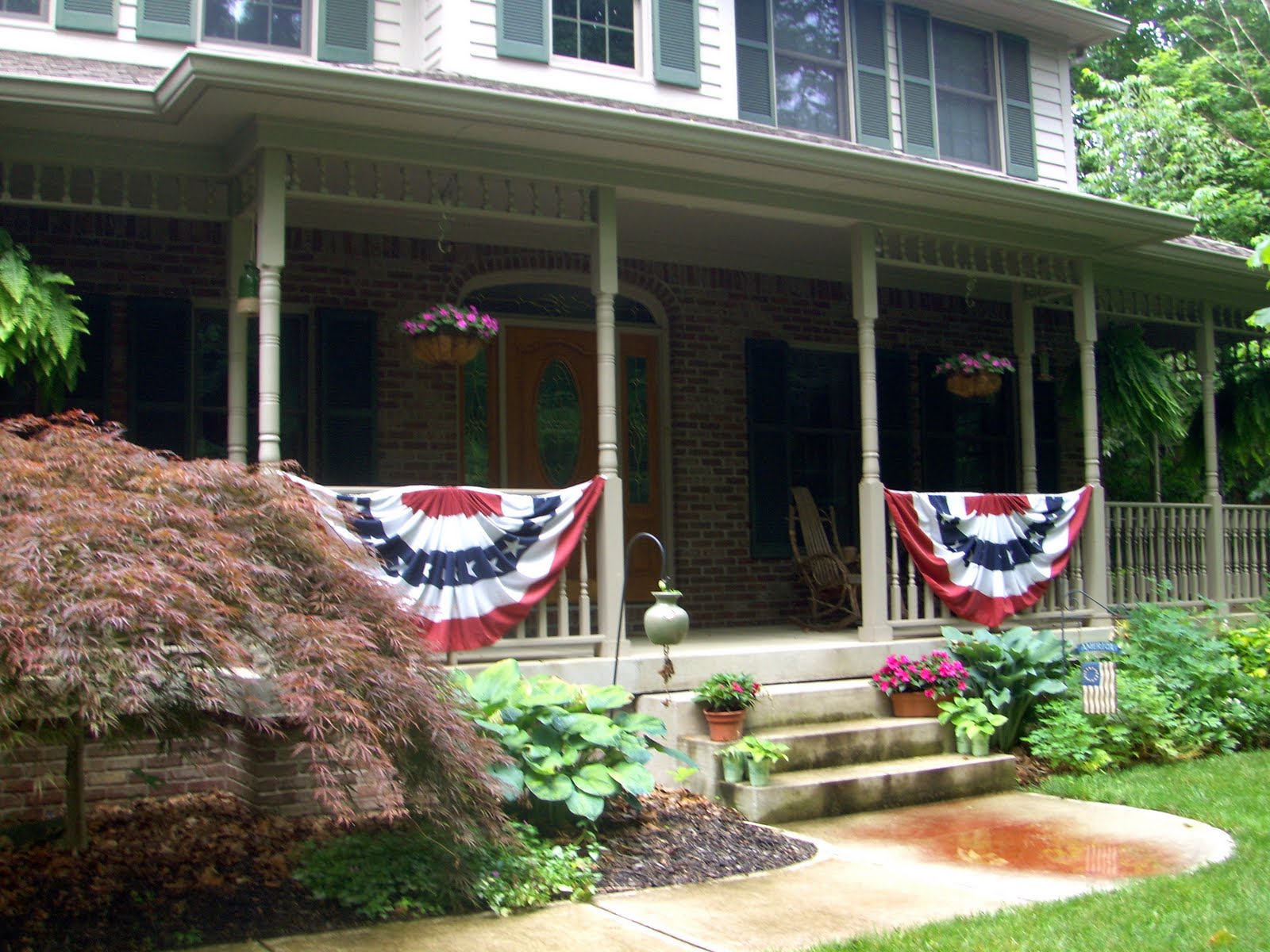
Our current home decked out for the 4th
Once I married and began my career, I moved from the big city to a much smaller community west of Indianapolis called Brownsburg.  Each year the town puts on a carnival called the Brownsburg Extravaganza, which is held in the largest of the town’s parks.  It runs for a few evenings, climaxing with a fireworks show on the final night.  When my children were young, we always made a trip to the fair to walk through the exhibitor’s tent and sign up for some lucky drawing or to stroll the grounds and play the games on the midway.  I have lost countless dollars to betting on which color of a hole a small mouse would duck into.  We rarely rode any rides, given that my children are strictly not the daredevil type, and it wasn’t long before they outgrew the few, simple “kiddie” rides they were willing to tackle.  Most of the time we didn’t even stay for the fireworks, given the late hour at which they were launched.  So as they have grown, the Extravaganza has fallen from our itinerary.  But one tradition that has persisted, albeit modified through the years, has been the annual parade.

David and Rebecca ready to head off for the parade
VFW color guard
Police color guard
The motorcylce squad starts the parade
The Brownsburg 4th of July parade is as purely American as a slice of apple pie.  You won’t find elaborate floats in this parade.  What you will see are little league baseball teams in the back of pickup trucks, the high school marching band with the new batch of incoming freshman making one of their first public appearances, and many old veterans of WWII, the Korean War and Viet Nam either marching as a color guard or waving from a car window.  The police and fire department join in with lights flashing and sirens blaring.  There is frequently a clown or two, and you can usually count on one or two equestrian units, as well.  Churches always have a large presence with numerous floats and members walking alongside handing out literature or cross-shaped pencils.  Local businesses such as insurance agents, heating and cooling companies or water damage repair specialists slap a vinyl sign onto the side of a sports car or pick-up truck and join the procession.  The town likes to show off some of its equipment, rolling out a few large trucks and a tractor or two.  Local politicians either ride in an open top car waving at the crowd, or if an election is not far off, they’re on their feet pressing the flesh.  There is always a group of farmers driving restored antique tractors, just as there is always a group of Corvette aficionados, revving their engines and showing off their sleek, polished cars.  I don’t know what the connection is, but you can always count on the Corvette owners to be waiving at the crowd with big Mickey Mouse hands.

Little ones waiting for their candy
However, the parade is more than what is rolling down the street; it is the people who come.  Beginning an hour or more before the scheduled kick off at the high school, residents are staking out theie positions along the route.  They gather on porches, in front yards and along the curb.  Many families have claimed their own special spots, and you find them there early each year camped out on their little patch of land.  Faces begin to look familiar after just a few 4th of Julys.  At various points along the way there are stands selling strawberries and shortcake in order to raise funds for the school band.  People usually dress in something patriotic, with red, white and blue the color scheme of the day, and of course flags are in abundance.  Some even bring their dogs to mingle with the crowd; although the sudden blast of a fire truck’s siren can send them scrambling.
The parade in the long stretch before the final turn
My favorite part of the parade is watching the children.  The main function of the parade’s participants is to toss candy to the crowd as they pass.  Children stand anxiously by the side of the road with bags in hand.  My family has always sat near the end of the route, just where the units make their final turn.  There is a long street they must traverse before making that turn, so the parade is heard long before it is seen.  Inevitably, there are always a few impatient children who must repeatedly run to the corner and peer down the street before running back to give a breathless update to their parents.  When not craning their necks to spot the coming parade, they proudly stand and wave small flags that are handed out in advance by the Lion’s Club.  Mothers, proud to show off their little ones, use the occasion to dress their babies and toddlers in their finest patriotic clothes.  Hair is curled and fancy, red, white and blue ribbons are attached.

Always plenty of Uncle Sams and tractors
We were no different when our children were young.  For years my wife would work to find the perfect 4th of July outfit for each child.  That morning, we would unload the kids’ wagon that sat in the garage and festoon it with small American flags.  Then with my daughter riding in the wagon and my son walking by our side, we would hike into town to claim our little corner.  Grinning broadly, both kids would wave at every person in the parade.  It drew lots of smiles in return and earned them lots of candy, even though my children never ate much of it.  Their father, however, was always more than willing to help.

Love the old time cars
My son is now 20 and a college student and my daughter is soon to be 17.  No longer does David accompany us, and Rebecca is now a participant each year.  A budding thespian, for the past few years she has had a part in the summer musical put on by Theater for Christ.  The group uses the parade as an opportunity to introduce the public to that year’s performance and to encourage them to attend.  So now it is only my wife and I sitting on the corner, but the feeling of rural Americana in the parade is as strong as ever.
The Red Hat Society on horseback

For me, my 4th of July tradition starts even earlier in the morning.  Since those early days of walking the kids into town, I have come to appreciate the walk almost more than the parade itself.  My wife drives ahead, usually dropping off several of the church group at the parade’s assembly point in the high school parking lot.  She is also responsible for bringing the chairs and our refreshments.  But for me, the real joy is in setting out on the 30 minute walk into town.  This morning, I left with a light drizzle falling.  We live in a wooded neighborhood, and as I strolled along the road leading out of it, I marveled at the buffet the birds have planted for themselves along the road.  On the left side there are no homes, only telephone wires running overhead.  Through the years. as birds have sat on the wires and “recycled” their earlier meals, they have seeded out those plants which now grow below in profusion.  There is a thick hedge of honeysuckle interspersed with wild cherry and mulberry trees.  Raspberries and blackberries grow below, and wild grapes weave their way through the canopy above. Here and there are scattered the occasional juniper.  Some elderberry bushes are present, along with now flowering plants that later will feed the seed eaters.  The fingerprints of the birds are all over this hedgerow.
Parade watchers relaxing out of the rain on their porch

I soon left my immediate neighborhood and moved into the older, more developed part of town.  I walked past the veteran’s memorial which is located in what used to be the small playground behind our first home.  Passing this I next came to a pair of neighborhood churches advertising their summer vacation Bible school.  I continued my stroll along the aging, broken sidewalks observing the detritus left over from last night’s small scale family fireworks.  There were blackened patches of concrete where the spark-emitting, pyrotechnic fountains had been ignited the previous evening, and the spent casings of those canisters along with the paper remnants of exploded firecrackers were piled high.  It is the modern day louder, flashier version of my playing with sparklers on the front porch as a boy.  Proceeding at a leisurely pace, I got to observe all those things that are lost to me when I usually pass by in the car.  I could admire the gardens of my fellow town residents.  July is usually a peak time for perennials to bloom, and I saw a large variety of day lilies, purple coneflower, daisies and hostas.  I witnessed a nice acanthus plant and a pair of impressive St. John’s Worts growing alongside gorgeous rose bushes.  Window boxes dripped with vines and blooms.  Many of the houses were festively hung with red, white and blue bunting and flags.  It was also an opportunity to look at who has taken time to maintain and improve their property and who has let it lapse into disrepair.  The houses along the main road are some of the oldest, and show the architectural detail that sets early construction apart from what we now have, although these were some of the houses in greatest decay.  All of this I observed protected from the rain drops by the canopy of the large catalpas and maples that lined my way.  
Flowers and flags

Little by little, more people joined me on the sidewalk, and eventually I could see the families ahead lining up along the road.  My wife was there in our predetermined spot with chairs in place and a small cooler of drinks at her side.  Patriotic music played from a speaker at the end of the street where the parade would be officially reviewed.  Soon, the police car next to us blocked traffic, sirens sounded and a color guard made up of grey-haired veterans with big bellies and bent backs, presented the flag.  From there the parade was as it always is.  Mother Nature smiled upon us and the rain gave way to cool, overcast skies.  The children scrambled for the candy, the floats passed by and small town America was at its best.
Flags, flags and more flags

In July of 1776, my great, great, great, great grandfather, George Fifer, Sr., a 23 year old farmer of German descent, frustrated with his British government and inspired by the recent declaration of the 13 colonies to unite and become an independent country, answered the call to arms and enlisted in the Pennsylvania militia in York County.  In July of 1862, nine days after the 4th, my cousin, Joseph Fifer, was seriously wounded at Vicksburg while fighting to preserve the Union.  His brother, as well as my great grandfather’s brother, would each die while also fighting to save his country.  And my father gave up his youth in the skies of occupied Europe in WWII fighting to preserve Democracy.  I think all would be quite happy to stand today and watch that flag pass, and to see those families freely coming together to enjoy this day of independence in the greatest country in the world; a country for which they fought so hard to establish and defend.   It is in their honor that we maintain this grand tradition. 

Happy July 4th!