Sunday, October 2, 2011

Priceless

    It is a 1923 Liberty silver dollar residing in an aged coffee can tucked deep within my closet and holding a life’s accumulation of old coins.  What distinguishes this dollar from all the rest, however, is a band of white medical tape wrapped around one half.  The value of the coin lies not in its silver content nor in some numismatist’s appraisal, but in the simple inscription on that strip of tape.  It reads, “To Scotty from Chuck and Frances and Sandra.”  It was a gift to me on my birth from the neighbors across the street, and for me that makes it priceless - a treasured gift from treasured friends.

Chuck's favorite game.
    I was blessed with a virtual treasure trove of such neighbors growing up.  Chuck and Frances Hearld happened to be the first to enter my life.  Chuck, a quiet man with smiling eyes and a demeanor to match, and his wife Frances, a woman with a harsher edge but who was equally as nice, were the neighbors who spent so many summer evenings sitting on our front lawn talking and laughing with my parents.  Chuck was a big kid at heart, and I looked forward to his visit each Christmas when he dropped by to see what new toys and games we had received.  Of course he wanted to share in the joy of the holiday, but he had a secondary motive.  The Hearld’s only child, Sandra, was quite a bit older than me, and I think Chuck missed playing with childhood toys and games.  The children of the neighborhood became his surrogate family, and through us he was able to satisfy his inner child.  I can remember one game in particular that caught his fancy.  Bas-Ket involved a series of spring-hinged levers spread across a cardboard court which could be used to advance a ping pong ball up and down its length and hopefully into the small elevated net on either end.  Chuck made multiple visits to our house that December to play our new game with us, and it wasn’t long before the Hearld household possessed a copy of its own.

The old bank book.
    Frances Hearld was one of the few women in our neighborhood that I recall holding a job outside the home.  She was a teller at the nearby bank, and it was she who set up my first bank account when Mom finally allowed me to cut open the large piggy bank (literally a chipper looking red plastic pig sitting upright with a small hat and bow tie) that had dutifully collected the family’s spare change (along with a few scattered receipts, ticket stubs from paying for the weekly newspaper and a small, slim back scratcher) for the first several years of my life.  I still have the AFMB bank book with Frances’ entries tallying my meager deposits and the humble interest they earned.  Despite her more stern and outspoken demeanor, I can still recall with great relief how both she and Chuck smilingly took the news in stride when I informed them that I had accidentally pushed my lawnmower through their basement window while mowing their yard.  A simple apology and a promise to promptly replace it was all they needed, and no more was ever said about the mishap.   A special gift to my family each summer was when the Hearlds allowed us to pick the cherries from the tree which grew in their back yard.  With Dad on the ladder and Mom, my sister and me picking from the lower branches, it wasn’t long until we had a basket full of delicious fruit which my mother then turned into the best cobblers I have ever eaten.

    All these years later, I can still picture an evening spent sitting on the front porch with my mother and next door neighbor, Julie Walker, bent bobby pins in hand, pitting a bucket of those cherries.  And it is that memory which brings me to the next jewel in my chest of treasured memories.  The Walkers were the family that lived to our east and their backyard abutted our side yard and driveway.  Julie was my age and had lost her father, Larry, when we were only about four years old.  Her mother, Dorothy, then barely over 40 years old, was left to raise three girls and a son on her own, and although she never remarried, she carried out her parental duties flawlessly over the remainder of her life.  I can still remember Dad and Dot, his affectionate name for her, having many conversations over the fence whenever he would be out working on the car or grilling out on our small, flagstone patio and she was outside working in her yard.  As I’ve noted in prior postings, it was Dorothy who always provided the popcorn when the neighborhood kids would gather on their corner to watch 4th of July fireworks.  Since we were the same age, it was Julie with whom I mostly played in the early years.  Any given day we could be found swinging side by side in my backyard, vainly trying to touch the telephone lines overhead, making mud pies in the sandbox, sipping nectar from the honeysuckle blooms that covered the large bush at the intersection of our yards, or we might be huddled together in the dog house that sheltered Tippy, the Walker’s dog.  On Sundays, we attended Sunday school together, and during the week we were in the same first grade class.  The middle daughter, Becky, was only slightly older than me, and she too became a great friend through the years.  She was the local tomboy and good friends with all the guys, perhaps by necessity since I can recall no other girls her age in the neighborhood.  Becky could hold her own in about any sport  and was proud of the fact that she was one of the best shots whenever we gathered to play basketball.  The oldest sister, Jane, was my sister’s age, and they naturally struck up a close friendship of their own.  Jane even accompanied us on vacation one year, but unfortunately, her fair skin was no match for the harsh Florida sun, and she returned home with a severe burn.  Larry, the son, was quite a bit older than me, and by default assumed the fatherly figure in the family once Mr. Walker had passed.  His passion was cars, and I never passed their house without catching him under the hood of his prized purple Duster, a car he still proudly owns.  

    Just north of the Walkers and adjacent to our backyard lived the Spillmans.  It was another relationship carried out over the fence which divided our yards.  So often Mom and Nettie would each be hanging laundry on the line at the same time and would invariably be drawn together at the fence to share the day’s gossip.  Nettie was a fun-loving, boisterous woman, and I can still hear her calling out, “Hi, Scotty!”  If she didn’t notice me, I would walk the length of the fence, rattling the woven wire with a stick until I managed to capture her attention.  Her husband Johnny, on the other hand, was a much more quiet man.  I never spoke much to Mr. Spillman, but my strongest memory of him is always seeing him in his work clothes.  I know I must have seen him in other outfits, but I can not picture anything other than his green work uniform with his name embroidered on the shirt.  I also have a vague memory of one day visiting with the Spillmans in their front yard when Johnny brought out a coffee can of assorted nuts and bolts and other assorted hardware for me to explore.  It was like a treasure chest to me, and I sat there under their front tree, next to the coffee grounds they used as mulch, playing with these “toys.”  The Spillman’s were the parents of three boys.  The oldest, Mike, was quite a bit older than me, so he was relegated in my early mind to that group of people known as “grown ups.”  Mark, the middle son, was a quiet young man with a large head of hair and a passion for gardening.  Most evenings Mark could be found puttering about in the back yard mowing, weeding or planting flowers.  I always expected him to pursue a life of gardening, but I do not believe that ever came to fruition.

Me with my Texas Ranger rifle. 
    Tim, the youngest Spillman, was the one with which I had the most contact, first as a friend and later as a coworker.  What stands out most in my memories of Tim, other than his good humor, was the fact that he was a bit of a jinx.  My first experience with this apparent hex came early in my life when I received my new Mattel  “Crackfire” Winchester rifle.” It was a toy gun which made the sound of a gunshot and a subsequent ricochet when cocked and fired.  Tim saw me playing with it in my backyard and asked if he could borrow it for a little while.  I leant him my gun and by that afternoon it was broken and silent.  His parents felt bad and bought me a new one, but this would not be the last time a toy would fall victim to Tim. In fact, I don’t even think it was the only toy gun to break in his hands.  I have a vague recollection of  my Texas Ranger rifle also returning nonfunctional, but I could be wrong.   A few years later I got a new, commercially made slingshot, a step up from the homemade versions I had created from branches out of the old apple tree and strips of an old leaky inner tube.  Tim was again intrigued, so I handed it to him across the fence.  He took the leather sling between his fingers and pulled back on the elastic when “snap,” half of the wooden slingshot broke off.  It was only one pull and had not seemed that excessive, and yet there was the arm of my slingshot swinging from the now limp elastic.  Again Tim felt bad and promised to repair or replace it.  And with the help of his father and a powerful horse glue, he did manage to reattach the arm of the slingshot.  The repair was sound, and the slingshot, which never broke again, is still in my possession some 40 years later.  It wasn’t just my possessions that fell victim to Tim‘s mysterious powers.  One day I was eating lunch when the sound of a small explosion sounded outside our backdoor.  I peeked out the back of the house to see Tim next door inspecting his bicycle.  Earlier that day he had inflated his tires but had evidently over-filled them.  The already compressed air expanded even further in the summer heat, and the rear tire of his bike had burst with a loud bang.  But the final proof of the “Tim jinx” came with my own bicycle.  Living in Indianapolis, home of the famous Indianapolis 500, racing was always a major interest in the month of May.  One year, the kids in the neighborhood decided to stage a bicycle race around the block on which we lived.  I was pretty small and didn’t feel I would be much of a contender, so I did not plan on joining.  Tim liked the look of my flashy three speed Swinger bicycle and asked if he might ride it as the “pace car.”  He wanted to take it on a trial run around the block, so I hopped off and handed it over to him.  Off he rode on my beautiful bike, but when he returned from his one lap around the block, there was my handbrake cable hanging free from the handlebars.  Yes, he broke my bicycle.  This time he even seemed to have a delayed effect because from that day forward, the red, sparkly banana seat started turning black.   I truly feel that none of this was ever due to abusive behavior; Tim just had bad luck.  
The slingshot with the glued arm visible at left.


    On the opposite side of our home, lived our true “next door” neighbors, the Pattons.  I first came to know them when their nephew, Timmy, came for a summer visit from Colorado.  Timmy was about my age, and we spent day after day playing with our Matchbox cars and singing songs of  the time. I can clearly remember our rousing version of “Hey There Georgie Girl” by the Seekers, complete with an outstanding percussion performance on garbage can lids and a Frisbee.  Because I came to know them through their nephew, for most of the years of my early life I referred to these dear neighbors as Uncle Bud and Aunt Donna, and I still view them with that same family-like affection.  It was Bud to whom my mother turned when the sewer backed up into our basement while father was in Oklahoma for postal training.  And it was Bud I consulted when, as an adult home owner, I was wanting to replace my patio doors which meant altering a header.  He had the construction knowledge and was the most trusted person I could think to ask. Sadly, like the neighbors already mentioned, Bud has since passed, but Donna remains a close family friend and was there at the nursing home visiting my mother only days before she passed.  She looks and acts just as I remember her in my youth, still maintaining her energetic spirit, bubby personality and her southern way of talking, including the term “youins” when addressing a group.
The neighbors and family gathered in the basement to celebrate my brother's wedding.  Bob and Ginny Garwood are on the left.  Chuck is second from the right as is his wife Frances.

    There were so many others who were just as near and dear.  There were the Sturms who lived two houses down.  Each summer they would come and pick our grapes and Catherine would turn them into delicious jelly.  Although I loved the jelly, what I most looked forward to was the circle of paraffin used to seal the jars.  I would chew that paraffin with its hint of grape as if it were gum.   And I can still recall with horror the morning their daughter Kay, who had spent the night with my sister, went into the bathroom, locked the door and had an insulin reaction.  She collapsed, falling into the tub and hitting the hot water faucet.  I can still hear her incoherent cries as the water scalded her legs, and my parents tried frantically to get into the locked room.  In the end, they were able to unlock the door, get some sugar into her, and she emerged with only some burns on her legs.  The years have claimed her entire family.  Kay, her younger brother, Bill and both parents are now gone.  
The comical newspaper clipping featuring Dad.

    Across from the Sturms were the Garwoods, Bob and Ginny.  Like most of the men of the neighborhood, I did not have much contact with Bob.  I remember him as a large man with a ruddy complexion who was a photographer for the local paper.  Only this year was I was reunited with an old newspaper clipping showing Bob’s picture of my father demonstrating the effects of overzealous celebrating on New Year’s Eve.  I don’t know the circumstances of the actual picture, but it was a comical warning to potential holiday revelers. My most vivid recollection of his wife, Ginny, was that she was passionately in love with the singer Tom Jones.  In those days, the Welsh musician had his own television show featuring a segment each week in which Tom came back on stage, loosened his bow tie and sang some sexy song.  Usually by the chorus the tempo suddenly picked up and Tom would dance and gyrate wildly, throwing the women in the audience into a mad frenzy.  When he would do the same thing on tour, the aroused women would throw their underwear and room keys onto the stage.  Ginny wanted to be one of those women, so my cousin Dewey, a doorman in Las Vegas arranged for Ginny to see a show and to meet Tom in person.  Ginny did not squander the opportunity.  In time, she and her daughter, Mariam, traveled to several shows across the nation, often meeting with Tom, dining with him, drinking champagne together, singing with him after hours in night clubs and keeping up a correspondence that lasted through the years.    I don’t know if she ever threw anything on stage, but she obviously made quite an impression on the man, nonetheless.
Ginny Garwood (left) eating fish with Mom.

    In those days, Ginny was the neighborhood Avon representative.  One morning a large group of us kids decided to have a big game of Cowboys and Indians.  Ginny, being well-supplied with small lipstick samples, decided to use them to apply “war paint” to each of the Indians, striping each of our faces with various shades of red.  Since that day I’ve never been able to look at a lipstick sample for what it was truly intended.  To me it will always be a tube of face paint.  The Garwood’s oldest son, Nick, was my brother’s close friend and partner in crime, even traveling with us on an early vacation to the Ozarks.  I say partner in crime because I can still remember the police stopping by our house one afternoon to inquire about some mischief in which Nick and my brother, Jerry, had engaged.  I don’t remember the details, but it involved BB guns and was nothing serious.  Now in their 60’s, Jerry and Nick’s remain good friends.
Evelyn knitting and singing while selling her brooms.

    One of the more colorful families comprising the neighborhood lived at the far end of the street.  Harry and Evelyn Davis were a blind couple with a pair of sighted children.  To supplement their income, Harry and Evelyn sold brooms on the corner a few blocks away.  Singly or together, they would head off in the morning pushing their broom cart down the middle of the street.  I always made sure to call out a greeting, but that was the extent of any conversing I ever had with them.  Evelyn, who I recall looking and dressing like a Russian babushka, would always be singing as she returned home late in the afternoon.  While this couple always seemed friendly and harmless, their son, Gilbert, gained a reputation as the neighborhood bad boy and bully.  I don’t think Gilbert acted out of meanness, I just think he was more mischievous than anything.  One day he may be throwing firecrackers at you, but the next day he might unwrap a roll of pennies and throw them down the street to watch kids run after them.  Being one to never turn down money in any form or denomination, I was one of the kids he could always count on to chase his pennies like a dog pursuing a tossed ball.  That is how I came to be in possession of the only steel penny I’ve ever owned.   Today that 1943 zinc-coated, steel penny sits in that same coffee can as the Hearld’s silver dollar.  
My prized steel penny.  Thanks, Gilbert!

    One of my best friends growing up was Bob Phillips.  Bob was a year older than me, but we spent a lot of time together in the summer.  I would ride my bike up and down the street in front of his house, or circling in his driveway while whistling “Oh, Susannah” until someone inside heard me and alerted Bob to my presence.  I don’t know why I chose this method over knocking on his door, but that is just how it evolved and was unique only to Bob.  For anyone else, I would ring the bell or knock.   I picture Bob in one of two ways.  In my mind’s eye, he is either shooting baskets or he is riding his green Schwin 5-speed bicycle.  Bob loved “popping” wheelies and would often ride most of the way down the street tilted back on his rear wheel.  One summer he got a bike with an extended fork welded onto the front, turning his simple bicycle into a chopper style.  I was very envious, but after trying to ride, or more importantly steer this modified bike, I learned it was more about looks than practicality.  I quickly abandoned my hopes of a chopper of my own.  Bob also had a penchant for spitting, and in the early mornings as we stood waiting on the school bus, he would position himself over a manhole cover and challenge himself to spit down one of the small openings.  He way have been a good athlete, and even was a starting forward on the high school basketball team, but Bob was the clumsiest friend I ever took to the lake.  I was much smaller and could weave my way through low hanging branches and shrubs with ease, but Bob fell victim to every loose stick or upraised root he passed.  He spent about as much time on his rump as he did on his feet, but it was all great fun.  I came to know his parents, Herb and Joanne,  through visiting with him, but I never developed the closeness with them that I did with my more immediate neighbors.  I do recall, however, that we always enjoyed shooting baskets with his dad in the evenings.    
My sisters and me sitting on the step with a neighbor, possibly Jeff Smoot.

    The list of names could go on and on.  There were the Flicks where I accidentally learned to ride my tricycle on two wheels - a style that would mark the remainder of my trike days.   Or the Kirshner house on the corner where their son, Rick, along with Bob Phillips and myself would wire firecrackers and hook them to a switch from a rocket kit, cover them in Vaseline and set them in the birdbath to blow up toy model ships or scare the feathers off of some poor, unsuspecting bird.  The Hensons lived in the corner house formerly occupied by an odd, little hearing impaired boy we called “Little Ricky,” and that is where I learned to shoot a pellet gun at targets in the garage.  The Galligans, the Wilsons, the Walsmiths, the Bryants and the Smoots were some of the other families with kids with whom I played.    And there were the mystery neighbors, as well.  Mr. Cinco, whom I rarely saw, worked on his large model airplanes on the other side of a cedar privacy fence that lined our backyard.  I could only hear their engines, but I could never get a good view of one of those planes.  There was also the gentleman behind us that I knew only as the “Bachelor.”  But whether they were well known to me, or just passing acquaintances, each was a special part of my childhood.  While my family may have been of modest income, I carry with me a wealth of memories that money could never buy.  And although the parents have since passed, and the children have married and moved away with their new families to neighborhoods of their own, I shall forever keep those memories safely secured within my heart, just as I keep that silver dollar stowed safely away in an old coffee can.

(A discussion of the neighborhood itself will follow in my next posting.  Those of you who grew up with me on Indy's east-side, please feel free to add your own comments and memories.)

Friday, September 23, 2011

Strolling Through TIme

                I took a stroll today that spanned not only distance but also nearly 30 years of my life.  The occasion was a return to Purdue, my old alma mater for my annual veterinary fall conference.  However, today I made a critical error in scheduling; believing an all-day lecture on clinical pathology was open to all attendees.  It was noted on the registration form that this was a session requiring separate registration and fees, but that form was submitted weeks ago.  All I was left with was my poor memory and an itinerary which listed only a clin path lecture.  So having taken a day off work, driving an hour and a half to West Lafayette and pre-arranging a lunch date with my son, a sophomore in the School of Science, I decided instead to spend my morning retracing the steps of my old college days.  

            After downing a cup of hot tea and a Danish meant for the "paying" doctors, I hopped back into my car and headed to the western edge of campus.  This is where I had lived the first four years of my seven as a student.  I did not travel there to visit my old dorm, but rather to seek out an escape that had served me well in my early college years.  My destination was Horticulture Park, better known as Hort Park, a clump of woods surrounded by a grassy area of rolling hills and together forming a 35 acre park.  It is scarcely known to the general student population so today, much as in 1980, one can find himself alone despite a student population of nearly 40,000.
The pond and bridge at Hort Park
            I first came to know Hort Park my freshman year when a girl with whom I had struck up a close relationship called me one evening and asked if I wanted to go for a walk.  So as the sun started its descent into the west, we left the dorm, passed the shopping plaza across the street and there found a lane that ran past the intramural fields and into the woods.  Following the lane, we first came to a scenic little pond on one side,  a house on the other and a small, arched bridge separating the two.  Passing by the pond we emerged into the park itself with a grassy hill sloping away to our left and the woods continuing on our right.  We located a path opening into the woods’ edge and followed it until we reached the far side of the park.  Here the woods ended at the back of an active dairy farm.  The Holsteins were grazing when they first heard us, and one by one their heads popped up and they started approaching the fence, forming a line opposite us.  For a while we just stood and stared at each other, and then a couple bolder individuals made their way to the fence to greet us and have their heads scratched.  Each cow had an ear tag onto which the farmer had written their names.  I recall some names such as Jane Dow, Blaze and March.  We talked and petted the cows until a whistle from the farmer, signaling the evening meal and milking, caught their attention.  Just as quickly as they had approached us, they now turned on their heels and headed back over the hill, forming a single file line and following the well-worn path to the barn which lay in the hazy distance.
The old dairy farm at dusk.

            Emily and I visited the woods on a few occasions.  One of the most beautiful walks came late one December night.  It was finals week and I had a math final the next day, but a heavy snow had started and the white stuff was piling up quickly.  Emily and I could not resist, so along with another girl, we bundled up, abandoned our studies and headed out to the woods.  It was well after dark, but the reflective quality of the snow illuminated the scene around us.  The snow was already a few inches deep and stood undisturbed on the arched bridge and frozen pond at the park’s entrance.  We ventured out onto the pond with Emily afraid the ice would break beneath us at any time.  Making my way a couple yards ahead, I decided to have a little fun by suddenly dropping to my knees and calling out as if I had just broken through the ice.  Emily screamed and froze in place before realizing that it was all just an act.  She quickly realized it was a joke, but her nerves were shaken.  It was quite a while before she rallied the strength to finish crossing the ice.  The snow was falling even harder now, and given that the woods are quite hilly the accumulating snow made the ravines treacherous.  Eventually, we abandoned the park and worked our way south to the airport.  There the blue lights pointing the way to the runways cast an azure glow to the snow.   We may have been limited on Christmas lights in the dorm, but those blue airfield lights stretching into the night before us more than made up for it.

Looking over the frozen pond on a snowy day.
Sara mooing at the cows.
            Eventually, I met Sara who would later become my wife, and Hort Park became a special place to share with her.   Even before I took her to meet my parents, I took Sara to meet the cows.  Just as before, when we appeared at the fence, the cows became instantly curious and came to investigate.  Perhaps they were lured by Sara’s mooing, a trait she carries to this day whenever she sees a cow. I remember one cow in particular that kept trying to reach out and touch her with its long, long tongue.  I can also recall one crisp autumn morning when we left the worries of school behind and strolled the woods and park.

Sara resting on an old grapevine in the woods.
            Today was also an autumn morning, but unlike that day decades ago, the sun was not shining and a cool mist hung in the air. Repeating the route I had walked so many times before, I strolled past the shopping plaza and found the old lane that leads to the park.  I first noticed that what used to be an intramural field is now a rugby field complete with bleachers.  Passing the field and emerging where the house and pond had once stood, I was faced with only trees and shrubs.  Everything was different, and it was hard for me to place them in my mind. However, a treeless depression filled with tall grass and jewel weed betrayed the pond’s old location.  How often I had sat there on a bench studying calculus or physics.  If it was warm and my classes ended early in the afternoon, I would grab my books and paper and head to the park.  I never sought out libraries because sitting on the bench beneath the large trees, watching fallen leaves skate across the water at the mercy of the gentle breeze and listening to the birds was the perfect counterpoint to the rigors of my studies.  On a couple of occasions, a pair of spaniels joined me.  I never knew who owned them, but the pair would come bounding out of the woods and plunge into the chilly water.  I would watch their canine version of synchronized swimming, with the dogs tracing large circles in the water or perhaps passing over top of one another while swimming side by side.  Eventually, they would climb out of the pond, run to my bench and shake themselves dry, sending a shower of water onto my homework.  Sometimes they would lay by me and warm themselves in the afternoon sun, but at other times they would bound off just as abruptly as they had arrived.  Another animal that had caught my attention while sitting by the pond was an albino squirrel that lived in the trees behind the house.  In fact, there was a family of them and I saw them on several occasions but only for one year.  Now like the squirrels, the house and the pond have vanished forever.  
Another view of the pond in winter.  This is not the home mentioned above.

            As I emerged onto the top of the hill I could visualize the students that used to sneak away from the dorms for a secluded spot to sunbathe.  Blankets and towels would be scattered about the hillside, and here and there someone would be tossing a Frisbee with a friend.  Today, it was just a damp, empty lawn.  I started onto the path and was soon swallowed by the woods.  It is easy to forget you are at a large, busy campus when all you can see in any direction are century old trees.  Many were felled several years ago when a particularly strong storm hit the area.  They now lay on their sides, some uprooted while others lay snapped and twisted where their diseased, hollow cores had given way.  In places where they have fallen across the old path, the university has cut out the sections blocking the way but left the trees to follow their natural cycle of decay.  The nut crops are now ripening, and everywhere I looked squirrels were busy hiding their winter’s stash.  One squirrel nearly became a meal himself.  I had slowly been making my way along the path when suddenly I heard a very agitated squirrel barking.  I looked to my right to see it, tail twitching with each raspy bark, clinging to the side of a tree trunk about 4 feet in the air just as a hawk made a close pass.  I could not tell if it was a true attempt to grab the squirrel or just a coincidence, but the hawk sailed on and, once it had calmed down, the squirrel scurried on up the trunk to continue gathering walnuts.  It was these same paths I had walked in the spring time looking at the wild flowers each April.  It was the first place I ever saw a white trillium or a lady slipper orchid.  I even did a little mushroom hunting, finding one or two morels one year.  The spring ephemerals disappeared months ago, and now the only color seemed to be the seed heads of the withering Jack in the Pulpit plants.

Spring ephemerals popping up in Hort Park on a sunny day in 1981
            I followed the trail to the far end of the park, but today there were no cows in the field.  In fact, there is no longer a dairy farm.  The near pasture is overgrown and the area in the distance has been dug up and mounded in preparation for some construction project.  I do not know what is being done with this area, but I do know my days of talking to the dairy herd are long past.  I turned and continued following the trail along the length of the field.  I was looking for an old house foundation that I recalled from my early explorations in the 80’s.  I could not remember the exact location, but I did find evidence of early habitation, nonetheless.  Various streams carve their way through the hills, especially after heavy rains.  In one area, the water has uncovered the cast off and broken china of a former family.  Like the skeleton of a dead animal, pieces of plates and saucers emerged white from the mud and gravel below.  Although I searched the area looking for anything of value, nothing had survived intact.  So I abandoned my archeological inspection and continued on my way.  
The woods looking eerie on a foggy morning 30 years ago

            By now the sun had broken through the clouds, and beams of sunlight, accentuated by the evaporating haze, punched holes in the canopy overhead and spot-lighted the forest floor below.  Another familiar site now came into view - a stately home peeking through the trees.  The property is known as Westwood, and it is the residence of the Purdue University president.  A fence now divides President Cordova’s property from the woods, but I don’t believe there was a fence in place when I was a student since I can remember exiting the park by walking down the president’s driveway.  In fact, one winter when snow had closed the university, some of the guys from my dorm had gone walking through the park and found themselves at President Hansen’s house.  They decided to build a snowman on the grounds, and rather than calling the campus police, the president came out to talk with them and to take pictures.  Afterwards, he and his wife invited the men in for some hot chocolate.  That was the kind of man Arthur Hansen was.  
My friends heading out on their winter expedition that brought them to the president's house

            I still had not found the old homestead, but a path branching off the main trail and heading back towards the center of the woods looked promising.   I did a right-face and moved along the new path.  It wasn’t long before I spotted it, a square platform of concrete in the middle of the woods.  This spot has always attracted me, not because it is interesting to look at, but because it invited me to imagine what sort of home had sat there and who may have occupied it.  Was it a farmer?  Was it part of the university faculty?  The answers will never be known to me.  What I do know was that it was a very small structure with a fireplace at one end.  The chimney had long ago collapsed, and now the slab is covered with the loose rubble and pieces of mortar.  It appears to have been fashioned from the river stone found on site, but the firebox was made of brick.  Digging through the rubble, the charred bricks are still evident.  As before, I began searching the area for any artifacts that might shed light on the home’s history, but other than scattered shards of the old window panes, there was nothing.  The only intact item I found was a blue marble half buried in the soil behind the old chimney.  It may not have been much, but it helped me feel a connection with the child who once lived there.  
The entrance to the woods

            The path led me back to the starting point, and as I emerged from the woods the sun again disappeared behind the clouds.  It was as if a magical light had been cast on the exploration of my old haunts, but now I was back to reality, sort of like Dorothy stepping out of the colorful world of Oz and back into the black and white world of her everyday existence.  Still having time to kill before meeting with my son, I did something I always enjoy.  I joined the throngs of students headed to their 11:30 classes and followed them back to campus.  I started at my old dorm and retraced the steps I had repeated thousands of times.  Like the park, the campus has evolved and changed considerably since my days at Purdue.  Where once I had played football and Frisbee, there now stands a dorm and parking garage.  Another luxury dorm has replaced the small, flimsy “temporary” housing that had been Fowler Courts for 30 years.  New buildings stand on what used to be green space on campus, and still others are in the process of getting face lifts.  But it felt so natural to fall in line behind these kids and head toward the heart of campus.  In my mind, I am still one of them.  I feel like the twenty-something year old kid who once shouldered his backpack and marched off to class.  It is only when I walk past a reflective surface and see the tired, overweight, middle-aged man looking back that the illusion is broken.  However, today reality was not mirrored back, and so I could remain lost in the dream of again being a college student.  I sat by the old fountain that used to mark the engineering mall, and from which I wrote letter after letter home to my parents and friends at other colleges.  The fountain was moved in my final years at Purdue, but it felt good to again sit by its splashing waters.  I then moved on to the strip of buildings that housed most of my freshman classes.  There was Stanley Coulter where I had attended psychology class.  Walking a little further I passed the chemistry building where both biology and chemistry classes met.  Just past this was Heavilon “Heave” Hall where I took my early morning freshman communications class.  Grissom Hall, named after the Apollo 1 astronaut from Indiana who died during a fiery accident on the launchpad, was also the site of an early morning class (I can’t recall which one) and completed the row of buildings.  I cut between Heave and Chem and returned along the engineering mall, passing the physics building, the electrical engineering building (“double E”) which once housed two tall antennas which were my early navigational landmarks along with the old smokestack, the mechanical engineering building and the chemical engineering building.  This was my home sophomore year as my engineering classes became more substantial.  This was also the year I realized that I did not want to be an engineer and changed horses in mid-stream to pursue veterinary medicine.

Those buildings marked my favorite years at Purdue.  The college experience was still new, I was growing and developing so much as a person, and I was part of the student family.  Later, once I was accepted to the School of Veterinary Medicine, my classes were all held within one building located far from the rest of campus.  I was to spend my last four years isolated from the heart of campus life and with the same sixty some odd students.  While they were academically the most important years of my college experience, those early years moving among the crowds of students, building new relationships, writing letters by the fountain or in front of the chem building, throwing Frisbee in the evenings on the intramural fields behind the dorm and attending the dorm’s social dances were by far the more formative and more enjoyable years.
Jeff Kirby jumps for a Frisbee while I get sidetracked with handstands in front of the dorm.

All good things must come to an end, and so too did my stroll about campus.  It was time to meet with David and share a lunch.  Even that has changed.  Gone are the cafeterias within each dorm were student waiters dished out one of three limited entrées.  Now only certain dorms have food courts, and they rival many current day restaurants.  The company was nice and the food was good, but the old residence hall comradery was missing.  My son is happy and is getting a better education than his mother or I ever received, but there are times I wish he could step into our shoes and take a walk with us through those earlier years.  Today, I am just  glad I was able to once again take that walk, even if most of it was through the fog of 30 years of memories. 

Tuesday, September 13, 2011

Gone Fishin'


“Gone fishin’ by a shady wady pool
I’m wishin’ I could be that kind of fool
I’d say no more work for mine
On my door I’d hang a sign
Gone fishin’ instead of just a wishin’”
            Bing Crosby sings to me from my iPod as I drive along.  He’s hit just the right sentiment in my opinion.  I’m looking out at one of the retention ponds that now dot the urban landscape.  The blue sky is reflected on the water which is broken into hundreds of little ripples by a light breeze.  The cattails are gently rocked by that same wind, and a swallow skims the pond’s surface.  It is a small scale version of a scene repeated so many times in my past.

            In my mind’s eye I’m not looking at a small pond surrounded by houses, but rather Raccoon Lake in the 1970’s.  My parents and I are tracking through the mud about to clamber into a small, flat-bottomed jon boat.  My old, canvas tennis shoes leave their muddy prints on the aluminum bottom as I climb over the seats, each with a life cushion resting in the middle.  I’m small and not a good swimmer, so I have my orange life vest strapped tightly around my chest.  I sit in the middle seat of the boat while Mom takes up her position in the bow.  Dad hands mom the fishing poles, the tackle box and the bucket of minnows before taking hold of the lip of the boat, lifting it off the mud and shoving off into the water.  With a knee on the front seat, he kicks his other leg over the side and gingerly makes his way to the back of the boat.  He primes the small outboard motor and gives several tugs before the Johnson engine belches to life, and we are off.

            Our destination is a steep bank several inlets away from our little cove.  The magic spot is where several trees have toppled into the water, the soil having washed from beneath their roots.  The vast network of branches below the water’s surface creates a perfect hiding place for the crappie we are seeking.   Dad guides the boat into position then lowers the anchor over the side.  The rope uncoils and slides through the pulley for a surprisingly long time, demonstrating that the steepness of the rock strewn bank above the water continues well below.  We’re not far from the shore, yet the water here is very deep.  As the boat swings into position, Dad drops the matching anchor from the bow of the boat, and again the rope hums through the guide until the anchor settles in the soft mud below.

            And now the fun begins.  Poles are distributed all around, and hooks are baited.  I’m still too young for this task so Mom scoops out a minnow and slides it onto my hook.  The minnow continues to wiggle as Mom casts out my line.  We use slip bobbers, so the orange and white float lies on its side as the line is pulled through by the weight of the minnow and a small lead sinker clamped a short distance above.  When the knot we have tied to the line reaches the bobber, it stops and the bobber pops to attention.  We measure our depth by the length of our fishing pole, so today we are fishing two pole lengths deep. 

            Mom and Dad cast their lines near mine, and we begin the waiting period.  The sun is warm on our backs, and Dad strips off his shirt.  A dragonfly pauses on the anchor rope for a moment before launching itself back into the air.  The water laps against the side of the boat, tapping out its steady meter and gently moving our bobbers slowly away from the boat.  After several minutes, one of the bobbers quickly dips then rights itself.  It dips again then suddenly disappears below the surface.  Dad jerks his rod into the air and begins reeling in his line.  The tip of the pole bends as the line traces a zigzag pattern in the water.  Finally, a silver flash appears in the murky water below, and Dad pulls a good size crappie into the boat.  The scene would be repeated over and over throughout the morning- the dancing bobber suddenly disappearing from view, a quick tug of the line then a squirming fish brought to the surface.  In between these catches, we’ve snagged a few of the trees branches.  Most of the time we are able to pull our line free, but on a couple of occasions, the tree has won and the fishing line has snapped.   The goal now becomes to gently reel in the remaining line while trying to coax the bobber to the boat, but invariably someone’s bobber will break free and float away.  My father is frugal, so when after a couple hours of fishing we decide to return home, the anchors are pulled free of the sticky clay which seems bent on keeping them forever fixed to the lake floor, and the boat is guided to the bank to retrieve our runaway bobber.  Later we will scale and filet our catch, tossing the small slabs of meat into an old cottage cheese container to freeze for future meals and the carcasses into a deep hole dug into the loamy soil of the adjacent woods.
My brother, Jerry and I (along with my little life vest) showing off our morning catch.
            This scene was repeated hundreds of times in our two decades at the lake.  The boats changed through the years.  When we first went to the lake, we borrowed a row boat before advancing to the jon boat.  I always enjoyed the rhythmic creaking of the oars in their locks as Dad pulled on the handles and sliced their blades through the water, creating miniature whirlpools that twisted away and swirled past me as I watched from the back of the boat.  Later we purchased a small speedboat, but by the end of our time at Raccoon, we had moved on to a comfortable pontoon.  Just as our boats changed over time, so too did our fishing spots.  There were always a few tried and true locations that could be depended upon for an almost certain catch, and still others which were chosen based upon the most current scuttlebutt of other fisherman.  However, there was one location which remained a constant each March and April.  Swollen by the heavy spring rains, the lake would rise and flood the wooded edges.  A couple inlets away, a grove of small maple and willow trees became a prime spot for spawning crappie.  This was the period of our small speedboat, and Dad would ease the boat into the trees then climb out onto its nose.  From this perch, he could pull the boat by hand from tree to tree and was in a good position to reach his pole even deeper into the flooded maples.  Here the fishing was fast and furious, and we had the added excitement of trying to retrieve our catch through the maze of branches.   This was the time of year my father most enjoyed. 
Me holding the crappie with which my mother won the fishing rodeo down at the lake. 
            Once spawning was over, we returned to our more traditional sites of felled trees or sunken stumps.  However, with summer came additional fishing opportunities.  There was always the early morning trip as the sun was just breaking in the eastern sky, but to this was added night fishing.  Our target fish was different at night with Crappie being abandoned for silver bass.  As the last rays of light faded into darkness, we would again head out onto the water.  A chorus of frogs would call from the water’s edge while screech owls hooted their eerie calls from the surrounding woods.   For the first few years, we joined our neighbors at a popular spot just outside our cove.  Several old stumps, accompanied by discarded Christmas trees, covered the bottom of the lake at this point.  To mark the spot, someone had tied an old Coppertone suntan lotion bottle to a long line and anchored it to one of the stumps below.  Boats would gather in a large circle around this bottle, and one by one they would begin lighting there Coleman lanterns.  I can still hear the sizzle as the wick would grow bright and the smell of burnt lantern fuel wafted up to my nose.  The lantern was then positioned over the side of the boat where it would start attracting a cloud of small insects.  As the insects swarmed, a good number would invariably fall into the water thus drawing minnows.  The minnows, along with the light from the lantern, attracted still larger fish, and these were our ultimate goal.  It always took longer than I liked for the fish to start biting, but once they did the action was fast-paced, and it took very little time to fill a stringer with bass.  

Author with the previous night's catch of silver bass
I will always recall the one evening when the fishing was especially good, and the stringer was filled to nearly capacity by some pretty good-sized fish.  It was late and we were pulling up anchor, but my father was reaching deep into the water behind the boat.  I thought he was having trouble with the anchor until I realized he didn’t even have the anchor rope in his hands.  When we asked what he was doing, he sheepishly answered that the stringer had accidentally slipped from his hand.  He even went as far as to troll the area with a bare hook on his line trying to snag the runaway fish, but of course he was unsuccessful.  Word quickly got around camp, and I can remember the next day one of the neighbors joked that his buddy had been out the night before and had miraculously caught a whole stringer full of fish.   Ah, good ole fish tales!

There was other fishing, as well.  Lazy, hot summer afternoons were the perfect time to fish for carp.  For us, carp were not for food but for fun given that they were by far the strongest fighters of all the fish that inhabited the lake.  My first experience with them was when I was about seven or eight years old.  My parents and I were fishing from the small row boat when I hooked a large carp.  I fought it valiantly, picturing the deep sea fishing I used to watch on Wide World of Sports, and I soon learned the sheer strength of carp as our little boat started being pulled along the water.  It was my very first carp, and I felt as if I had just landed a marlin.  This is the only time I can remember carp fishing from the water.  Usually, my carp fishing was from the bank or from a boat tied up to shore.  Many summer afternoons, I lounged on the back of our pontoon, one eye on my pole and the other eye on a teenage girl about my age that usually appeared on the opposite bank for an afternoon swim.  I landed lots of carp, but I never did meet that girl!

Our never-failing bait was a dough ball made from stale Wheaties and garlic powder.  A small ball of this formed over a treble hook was irresistible to a passing carp.  For me carp fishing is a much more relaxed form of angling than either crappie or bass fishing.  You cast out a line without a bobber since the carp are bottom feeders, reel in any slack until there is just a gentle curve of line extending to the water, and then you wait.  As the carp take the bait, you notice that the bowed line suddenly tenses and jerks.  You must still wait a little longer until the line starts playing out and moving away. That is the time to set the hook and the fight is on.  Carp are extremely strong, and one must be careful because they are good at diving for cover.  I have lost several carp to broken lines as they swam into brush or around dock posts.  As I’ve already said, carp are not considered a fish worth eating, so we would release them at the end of the day.  A special treat, sort of like grabbing the brass ring on a carousel, was catching a goldfish.  Only my mother seemed capable of this, almost always hauling in a 12 to 18 inch bright orange fish with each outing.

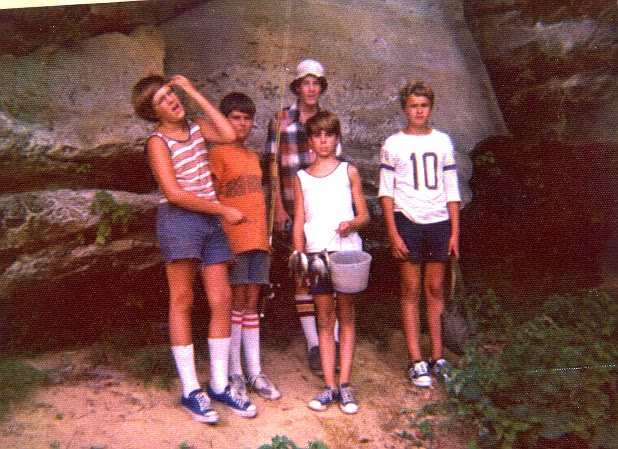
Small crappie and bluegill caught from limestone ledge high above the water.
Through the years there were variations on the theme.  There was the early period of cane pole fishing, fishing for bluegill at a nearby pond, cat fishing with stink bait, unsuccessfully attempting to catch crappie with jigs, a cold and equally unsuccessful attempt at ice fishing, fishing from high above the lake on a limestone ledge, and trying for largemouth bass with lures.  My bass fishing period was short-lived but eventful.  On my very first day of trying for a largemouth, I had hoped to use a frog lure that was in my brother’s boat.  He didn’t want me to disturb his own fishing, so he tossed the rubber frog lure to me, missing my boat and sending the lure slowly drifting to the bottom of the lake.  He then fished around in the tackle box, found a Hula Popper and tossed that to me successfully.  I tied it onto my line and started casting at some willows, slowly popping the lure back to the boat.  On about the third cast, there was a loud splash as a huge lunker rose to hit the lure, and I immediately set the hook.  It was putting up an incredible fight, and my brother, who earlier had not wanted me near, suddenly took an interest in the battle.  As he paddled his boat which contained the fish net towards mine, he coached me on how to slowly ease the fish to my boat.  At one point the bass jumped free of the water, impressing us both with its size.  But just as my brother arrived, the line snapped and my trophy fish was gone!  I was heartbroken but now more determined than ever.  That afternoon I went to Ebert’s, the small family run fishing/grocery store that supplied the camp with all its needs, and purchased a new Hula Popper.  Early the next morning, I was back at the clump of willows casting out my line, when suddenly a large bass jumped in front of me.  I looked at the growing rings of concentric circles marking the spot of the splash, and there floating on the water, where the fish had just jumped, was the lure I had lost the previous day.  Could it be that the bass I had hooked just 24 hours earlier had reappeared to spit out my lure and mock me?  It seemed like a fishy version of “Fool me once, shame on you.  Fool me twice, shame on me.”   I retrieved my “lucky lure,” but never again was I able to hook a largemouth.

My lucky Hula Popper

The memories drift away as Bing and Satchmo are winding down the song, the pond well behind me in the distance.  It is emblematic of my fishing experiences since they, too, are well behind me.  It has been 30 years since I’ve seriously fished.  How I miss those quiet days on the water and the mornings and evenings spent with my parents.  I would love to cast a line back in time, hook those days and pull them back to me, but that is just another one that got away.