Sunday, August 19, 2012

Flying High

            It was a beautiful, hot August afternoon in 2008, and my brother, my sister and I were, in a manner of speaking, about to open our Christmas presents.  Perhaps I should speak of it singularly, since it was a combined gift from our father.  We were about to have the opportunity to take a flight on a restored B-24 Liberator, better known to my father as his “office” during the Second World War.   This once in a lifetime opportunity was indeed an early Christmas gift from our father, and one that will likely never be matched.
            The B-24 Liberator is the often overlooked little sibling of the more glamorous B-17 Flying Fortress, yet this is not the result of performance but of publicity.  In Hollywood, looks are everything, and having garnered the nickname of “the Flying Boxcar,” its silhouette certainly did leave something to be desired.  Yet in many ways the B-24 outperformed its sleeker and more illustrious counterpart.  The Liberator could carry a heavier bomb load, and do so flying faster and farther than the B-17.   And its reputation has nothing to do with numbers, either, as the B-24 was the most produced of all the Allied heavy bombers and still holds the distinction of being the most produced American military aircraft to date.  However, despite 18,400 of these planes being built over the relatively short span of its production life, only a handful exists today, and of these only a couple are capable of actually flying.  We were about to board the only fully restored, flying model B-24J in existence.
Dad's main plane during the war

            The plane is owned and operated by the Collings Foundation, a non-profit organization created in 1979 to share the nation’s heritage through “living history” events, and while they originally focused on land transport, their focus shifted more to aircraft in the 1980’s.  Today their Wings of Freedom tour brings fully restored WWII aircraft to venues throughout the United States.  Flying together are the B-24, a B-17, and a dual-control P51 Mustang.  A couple of times before, we had gone with Dad to a local airport to see these planes and walk through the two large bombers.  The B-24 has gone through a few incarnations through the years.  The first time we saw it, it was the silver, unpainted All American representing the 15th Air Force.  A year or two later, the scheme was changed to the Dragon & His Tail, a ship that had served in the Pacific.  On the day of our flight, and still today, she  is painted in olive drab and carries the colors and insignia of the plane Witchcraft, a noted aircraft of the 8th Air Force which is the branch in which my father served.
My first view of an actual B-24 back in 1993
Several years later the plane returned as The Dragon and his Tail

It is an emotional and heartwarming scene to see aging WWII vets proudly showing off “their planes” to their children and grandchildren.  For many, it is the first time they have seen or stepped back onto such an aircraft since the war’s end.  Sometimes you can see one of these men standing off to the side, looking up at the plane with a faraway look in his eyes, and you can only imagine what past scenes of action or horror must be playing themselves out in his memories.  For others it is more like an emotional reunion with a long lost love as they reach out and touch the skin of the plane ever so softly.  Children, on the other hand, seem to be drawn to the 50 caliber machine guns projecting out the waist windows, where they grab the controls and take aim at imaginary Messerschmitts. 
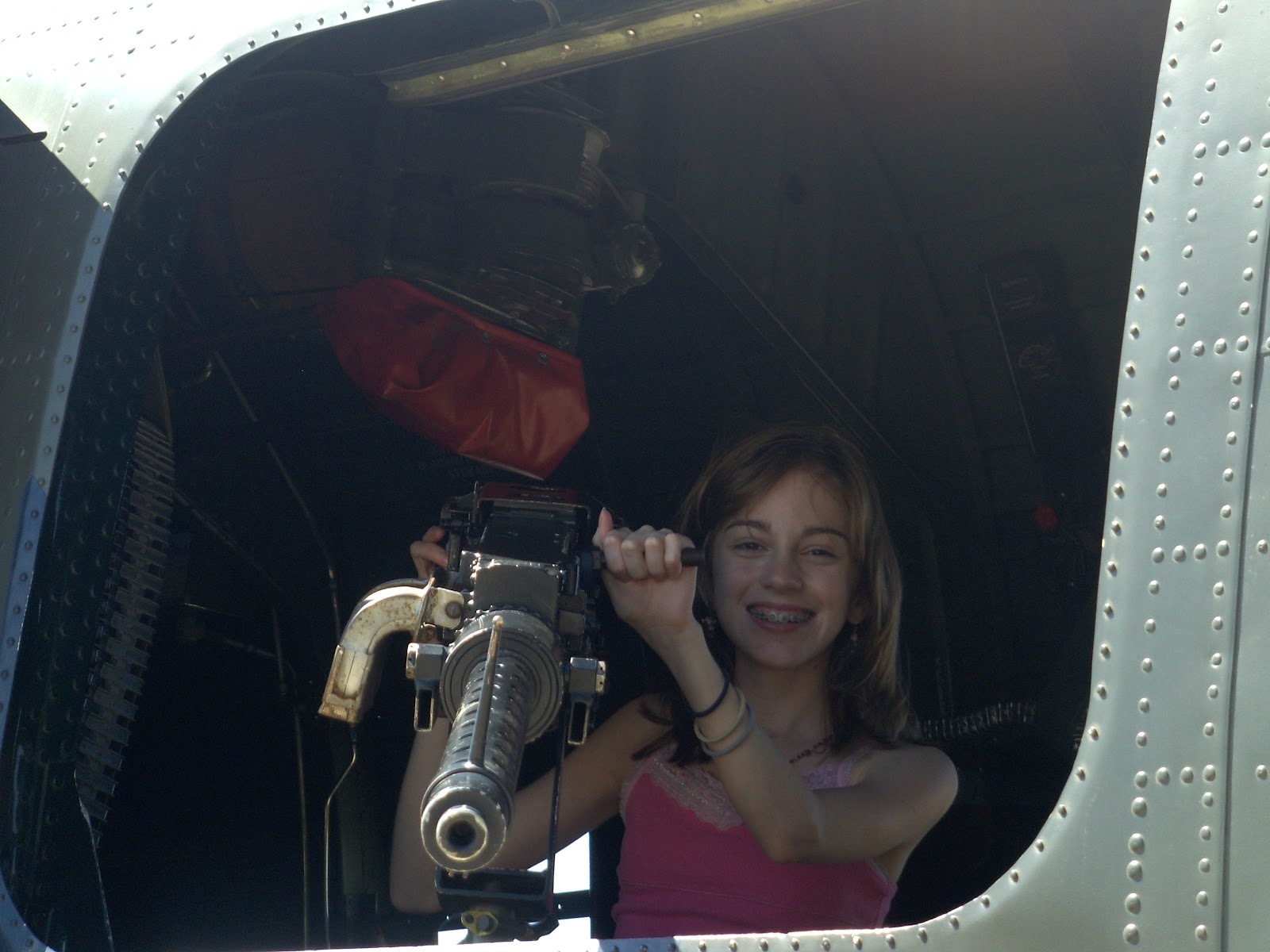
My daughter, Rebecca, finding the 50 mm gun in the waist
A look at her from inside the plane

For me, my first walk through of the plane was an opportunity to “put a face” on the stories my dad had recorded during the war.  And on this particular day, it was an opportunity to have life breathed into those tales.  Only once had I ever seen the plane powered up.  My wife and I had taken Dad’s brother out to Mt. Comfort Airport to see the two vintage bombers.  Uncle Earl had never had the opportunity to see or explore the plane on which his brother had served during those fretful years away from home.  Unfortunately, we had misread the details in the newspaper, and when we arrived there were no WWII aircraft in sight.  We talked with the office and learned the planes were scheduled to arrive in about an hour, so we decided to sit in the shade and wait it out.  After what seemed an eternity, a low rumble in the distance caught my ears and soon the silhouettes of two large aircraft appeared overhead.  As they banked to make a sweeping circle before their final approach, I could see the twin tail fins that are perhaps the B-24’s most recognizable feature.  That moment was an emotional one for me, and tears welled up in my eyes.  It was as if an ancient dinosaur had just been resurrected from a fossil.  The plane that had until that point only existed in grainy, black and white footage and wrinkled snapshots from the war was descending from the sky right in front of me.  I felt like one of the ground crew back at Horsham St. Faith, where my dad had originally been stationed, sitting by the tower and counting the ships as they returned, praying “their plane” was one of the group to make it home.  The planes in turn touched down and taxied to a corner of the airfield where they would later be available for tours.  We were not able to visit the plane with Uncle Earl that day, but Dad brought him back the following morning to give him a more personal tour.
The ground crews and officers awaiting the planes' return at the tower in Horsham St. Faith

And so it came to be that here we were again at that same little airport awaiting our chance to actually fly in that magnificent plane.  The bombers were still available for walking tours, and so we first visited Nine-O-Nine, the foundation’s B-17.  What struck me was how much tighter the interior of the plane felt to me, and I thought of how difficult it must have been for the airmen to quickly maneuver through a disabled plane to bail out. Then we climbed up through the bombay doors into belly of the B-24.  Of course my daughter headed to the machine guns, but the rest of us gradually worked our way to the front section to peak into the cockpit.  Dad was happy to share his knowledge of the plane with other families walking through, and a couple other veterans could be heard doing likewise.  Once our tour was over, we gathered again on the tarmac to await our flight.
Dad talking with my wife, Sara, before our flight
 While we were loitering, the individual who had purchased time in the P-51 got his chance to go airborne and take control of the Mustang.  The spectator/pilot climbed into the front seat, the true pilot into the back, and the plane sputtered to life.  With sunlight gleaming off her bright, aluminum sides the impressive fighter plane bearing the name Betty Jane rolled off the tarmac and to the end of the runway where it pivoted and began its charge into the wind.  It took to the air and quickly rose into the clear blue skies, made a loop around the airport and was then gone from sight.  My heart only raced faster after watching this, and just as it began to settle into a normal sinus rhythm once more, the Mustang returned and buzzed the airfield with a spectacular low-level pass.  Now I was really chomping at the bit to start our own flight.  
The beautiful P-51 Mustang, "Betty Jane"
Yet more time passed until those of us flying were finally gathered together for a pre-flight briefing.  Dad had chosen not to accompany us.  He wanted this to be for his children and not so much for himself (his enjoyment was watching us experience it.)  And he figured he had given the B-24 enough opportunities to claim him; he didn’t need to try his luck one more time.    We were given a brief history of the aircraft followed by instructions.  We were to find one of the available seats in the plane, either in the waist or immediately behind the pilots, where we would buckle in for takeoff.  Once in the air, the pilot would ring the bail-out bell signaling we were free to get up and explore any part of the plane we desired.  We were cautioned to be very careful on the narrow catwalk that led through the bombay because the weak bombay doors would not support a falling person, and one would quite likely plunge through the bottom of the plane.  Likewise, we were warned against grabbing any of the cables running alongside the plane, as these were the flight controls and the pilots preferred it if we did not try controlling the air surfaces ourselves.
Author sitting at the radio operator's table
With our lesson over, we once again crouched under the plane and entered the bombay area.  I had purposely pushed my way towards the front of the group because I had one particular seat in mind.  I wanted to experience the take-off from the radio operator’s table just behind the co-pilot.  This had been my father’s view of the war, and I was determined to experience the flight from his perspective.  In fact, this is where my father was sitting on just his third mission when he observed the following on March 8, 1944-
  “I must say it is sure a grand feeling to be back in England tonight and I don’t care much for England.  We had quite a day as we went to Berlin known as “Big B” to us.  We flew Satan’s Mate and everything went pretty well until we got into heavy flak at Hanover going in.  Capt. Booth was flying as Command pilot and at that point he was hit by a piece of flak.  I was standing right behind him and when he jumped about a foot off the seat I thought his electric suit had shocked him.  The flak took the tips off the fingers of his right hand, the top off his right knee and then lodged in the back of his left leg.  We were at 25,000 feet where it was 40 below zero so the wounds didn’t bleed much.  I called Lt. Moore up from the waist and we did what we could for the Capt. then Moore took the co-pilot seat.  I kept working with him.  His electric trousers were in such a condition I was afraid they would short out so I disconnected them and turned the heat up on his coat & gloves.  I wrapped blankets & coats around his legs to try and keep them warm.  I don’t think he will be handicapped permanently but he will be laid up for some time.  He sure took it like a man and wouldn’t let me give him any morphine.  I should’ve anyway.  We went on in and the group did a swell job on the ball bearing factory.  I got a glance at it and it was in ruins.  I was pretty busy most of the time but it seemed like we would never get home.  We had some bombs hung up that we couldn’t get out so we landed with them to get the Capt. to a doctor.  We had about 10 flak holes.  One life raft was ruined.  Two of our ships are missing. The 8th air force lost about 35 heavies today.  (Toll’s guns were froze all the way)”
An injured Captain Booth being downloaded from the plane
Pilots going through the pre-flight checklist
            Thankfully, the seat was open and I swiveled out the small, radioman’s chair and buckled myself in.  From this vantage point, I could watch the pilots at work going through their extensive pre-flight checklist, just as Lt. Clark and Lt. Moore had done 60 years before.  Outside, the engineer pushed each propeller through a full rotation before the pilots could start the four 1200 hp Pratt & Whitney engines.  Eventually, the engines fired and warmed to build the necessary pressures to ensure a safe take-off, and ever so subtly the plane began to roll.  The engineer was standing next to me when suddenly he popped open the emergency hatch on the roof and climbed up.  There he sat perched on the plane’s roof between the cockpit and the top turret and became an extra pair of eyes for the pilots as they taxied to the end of the runway.  Slowly the plane turned and waited for the okay to take to the air.  At that point, the engineer dropped back into the plane and fastened his own seatbelt, and the race down the runway began.  It seemed like forever before the plane separated itself from the ground, but eventually we were airborne and the pilot immediately rang the bell.  As much as I loved sitting in my father’s seat, I wanted to see the rest of the plane.  Being near the front, it made the most sense to just move forward, and besides, that was a part of the plane I had never visited even on the ground.  I dropped below the pilots and made my way to the nose of the plane.  Here is where Lt. Haley, the navigator worked, plotting their course or taking positions through the astrodome above.  And here is where Lt. Hoobler had guided the bombing runs from a prone position as he gazed through the top secret Norden Bombsite in the nose.  Making my way through their cramped quarters I came to the nose turret where my dad’s crewmate Demkey had watched for attacking German aircraft.  Although the view was interesting from there, I was anxious to head back into the belly of the plane, passing my brother headed in the opposite direction since his goal was to get the bird’s eye view from the nose.  I passed what would have been Okie’s postion in the top turret on my way back to the bombay.  
Dad's crew in front of their training plane
            Here is where my father would peer through the open doors to watch the bombs release and tap out a “bombs away” signal, just like he did in this mission from June 22, 1944. 
    “I think after today we’d better thank the Lord for little favors.  Capt. Mitchell flew with us in our own ship leading the 491st to another noball target northeast of Abbeyville.  There was just a few scattered clouds so we bombed visual and with excellent results.  I hope I never see or hear any more flak as I did today.  Those gunners were sure putting it up around that lead ship.  We got into it on the bomb run and most of the way out.  It was very heavy and too accurate.  When it gets close enough to hear it’s too close.  Again it was impossible to get out of it and as the result our ship was hit all over.  I guess we had about 150 holes.  There are 12 gas cells and 11 of them hit.  Toll had some plexiglass knocked in his face when a piece went through the dome of his turret.  I was down by the bomb bays watching the results of our bombs and the command pilot was looking over my shoulder.  He says I ducked once but he must of been wrong cause I never raised up.  We got hit in the bomb bay just before bombs away.  Those rocket sites have first priority now that they are hitting London.  I think the Germans have their best AA gunners protecting them too.  Our ship will be in Sub Depot for some time.  I think I broke all speed records for sending in a bomb strike message today. We were still in flak so I didn’t waste any time.  They got it the first time.  I wonder if the guy who copied it had any idea how scared I was just then.”
View of bombs striking their target in St. Trond, France

The narrow catwalk coursing through the waist
            I eased my way along the narrow catwalk, past the raised ball turret where Donovan, the smallest guy on Dad’s crew, would squeeze himself in, and found my sister in the waist.  This is where two of the plane’s ten 50 caliber machine guns reside, being manned in my dad’s time by Innis, the crew’s waist gunner.  This became my favorite perch for the flight.  With open windows to allow for the guns, I could lean out and feel the air on my face and watch the world pass below.  Rather than the hedgerows of England, I had to content myself with the patchwork farm fields of central Indiana.  And standing in for the English Channel was Geist Reservoir.  Speedboats pulled skiers below me on this day, but with a little imagination the scene could be altered to what my father looked down on the day after D-Day when he wrote this in his journal-

My version of the English Channel
The Hoosier countryside standing in for England

            “Oh, what a day!  I must say this was the most interesting so far.  It was our first since moving to Hardwick.  We led our old group, the 458th to the town of Lisieux, France just past our troops.  The bombing wasn’t very good as the G.H. Beacon wasn’t working and it was a little too cloudy for visual bombing.  We didn’t encounter any flak or fighters but we had to feather #2 because the prop ran away.  It was clear just at the beachhead.  Below was the most exciting scene I ever expect to see.  The Channel was full of ships, boats, landing craft, etc.   There was all kinds and sizes with hundreds of allied fighters giving them cover.  The battle ships were shelling some coastal target and some coast gun must have returned the fire cause I saw some hits very close to one of our large ships.  I hope we get to go back tomorrow!”
Our shadow follows us below
Not exactly standard pilot uniform
            I watched the plane’s shadow chase us across the ground below.  It was the perfect day for a flight with clear skies and warm weather.  My father had to fly through the thick muck that makes up the English weather in the springtime.  We were clothed in shorts and shirtsleeves, but my father’s crew flying at such high altitudes in an unpressurized aircraft wore warm underwear, an electrically heated flight suit, with a two piece heavy outer suit of leather and sheepskin.  Over this they wore a parachute harness, a flak suit, leather flying helmet, gloves, goggles, heavy boots and a flak helmet, not to mention an oxygen mask.  The temperature was often 40 degrees below zero, and exposed skin quickly succumbed to frost bite.  The bulkiness of their flight apparel made it all the more impressive to me that they could maneuver and perform in such tight quarters. 
View from the tail gunner's position
            When I had made my way back to what had been Tolleson’s position as the tail gunner, the bell again sounded, and I had to find a seat once more.  Reluctantly since I did not want it to end, I sat by my sister in the waist and buckled up awaiting our landing.  I had expected this aging, clunky bird to set down a little hard, but to be honest, I never felt the contact with the ground.  It was as smooth as silk and better than some of the commercial flights I’ve taken.  For my siblings and me the trip was over, but the memories will last a lifetime.  
B-24 going down

Nothing can ever show us what combat was like for those men.  Statistics tell us that early in the war they would most likely not survive their full 30 missions.  We will never again in our lifetimes see the vast armada’s of heavy bombers filling the sky as far as the eye can see in all directions.  How can we appreciate the terror of seeing the black puffs of smoke around the plane and knowing that at any minute shrapnel could rip through its fuselage, taking lives, maiming crewmates or disabling the craft?  We will never know what it is like to have waves of enemy fighters repeatedly dive at your formation while you are forced to hold a steady course, while the sounds of your crew’s machine guns returning fire rings in your ears.  We cannot fathom the fear a crew surely felt when their plane became crippled and they had to drop out of the protection of the group formation in hopes of limping home alone over enemy territory, knowing all the while enemy fighters were waiting to pick them off.  We will never know the pain of seeing the faces in the barracks and mess hall change daily or weekly as your friends fail to return and new crews take their place.  Each plane that went down took with it 10 men.  The fear and subsequent relief when such missions ended is well reflected in my father’s final journal entry.  The date was August 8, 1944 and Dad was flying his 30th and final mission with the 93rd Bombardment Group when he recorded the following-
            “It seems that my roughest missions always come on the 8th of the month as my four worst missions have been on that date.  Today was the last one in this tour and I’m greatly relieved.  I flew with Capt. Darughty today as his radio operator is finished.  We went in at 14,000 feet which is the lowest yet and a mile or so too low to suit me.  We were by ourself  but this time I was glad cause if we’d had a formation with us I don’t think we would be here to tell it.  We were to drop five British flare bombs on the target which was a small village just in front of our own troops.  The reason was to make it so the first & third division of forts could pick up the target easier and be sure on not getting behind our own lines.  It was very interesting as we went in over Cherbourg.  There was a couple of convoys heading into the port.  It looked like the harbor was pretty well cleaned up as it was full of shipping.  I could see about five small vessels the Germans had sunk to block the harbor.  The shell holes in the large harbor forts were very visible.  From there on I saw lots of villages that were mainly shell holes & crators.  The red crosses marking the hospitals were very plain to see so there really shouldn’t be any excuse for the Germans to bomb them.  They’ve built a great number of aircraft landing strips.  I was really enjoying it till we got to Vire and turned on the I.P.  At about that time we crossed the German lines and did they ever give us the works.  I never saw so much flak in my life and it was accurate.  I think a lot of it came from German tanks cause their 88 mm will reach 14,000 feet easily.  Anyway as we were by ourself we did violent evasive action to try and get through safely.  We turned as high as 90 degree turns but is was still too close for comfort.  We got the flares on the edge of the target but I don’t know how we did with such a bomb run.  If we held a course for a few seconds the flak was right on us but the navigator & bombardier did a grand job.  The bombardier took the shortest run I’ve ever known but it was good.  By the time I got the bomb doors shut after watching the flares hit, we were at 16,000 feet and climbing fast.  It was just a couple minutes till we were back over our lines but we were in that heavy flak for about 15 minutes. I think there were 10 of the scaredest men on that ship I’ve ever seen.  Maybe it was because it was the last mission for 8 of us & 29 for the other two.  We really came home in a hurry.  The forts were suppose to come in at 12,000 feet and they couldn’t do very much evasive action as they were in formation.  Flak got the first three forts.  Our fighters were down on the deck strafing every gun they could find so it was quite a sight to see.  We were very lucky cause we only got hit about 15 times.”
Dad posing with his kids after the flight.
             Our father was grinning broadly as we each climbed from the plane.  He had given us one of the most memorable days of our lives, and opened a small window onto a very special time in his own life.  I am forever grateful to the Collings Foundation for maintaining these rare aircraft and for offering these special flights.   I thank Dad as well all the men and women who have ever worn the uniform of our country for their service and sacrifice.  And I especially thank him for a very special Christmas present, opened on a hot sunny afternoon in August several years ago.

****For those interested in reading the entire account of my father's war experience, you will find his journal at http://aradiomanslog.weebly.com/

Sunday, July 1, 2012

Liftoff!

Photo courtesy of http://www.spacefacts.de/graph/sts/launch2/sts-3.jpg
                The wind pushed the rain under the umbrella regardless of the angle at which I held it, soaking my lower pant legs and shoes.  It was one of those cold, wet March days that I had come to hate in my time at Purdue.  The grey and gloom of late winter was wearing on my emotions, and I was chilled to the bone.  Having finished my morning classes, I was making the long trek back to my dorm, all the while thinking, “Ugh!  I have to head back out into this stuff again this afternoon.”  Collapsing my umbrella at the door and shaking off the water, I headed up the short flight of stairs to the dormitory when I ran into one of the guys from my floor.
                Steve, a student in aeronautical engineering, approached me and said, “You wouldn’t know anyone interested in going to Florida to watch a shuttle launch, would you?  We need someone else to split the gas money.”  The space shuttle was NASA’s latest adventure into space, with only two flights having yet occurred.  As an engineering student, Steve had been given a pass to go onto the base to watch the liftoff.  He and Dave, another resident from the second floor, were committed to the trip but were hoping to find a third to make it affordable.  Thinking they wanted only another aeronautical engineering student, I could think of no one in particular.  Because the plan was to leave that evening, they wanted to find someone ASAP.  I told them I would let them know if I thought of anyone, then headed on down the hall to my cramp little dorm room.  Sitting on my loveseat and looking out the window at the overcast skies and raindrops dancing in puddles, I began thinking I could sure use an escape.
                My job working in the cafeteria at McCutcheon Hall had given me a little spending money, and with the exception of an occasional movie and Sunday evening pizza, I did not part with it.  The end result was that I had a small nest egg tucked away in a savings account in the bank across the street from the dorm.  I looked out my window at the parking lot, and watched a couple of guys run from their car to the building, holding their folders above their heads to shield them from the cold rain, and my mind was made up.  I wanted out of there.  I needed an escape from the rain, from the wind, from the cold and from the colorless Indiana landscape.  Although I had entered the independent stage of my life, I still wanted final approval from my folks, so I phoned them to ask what they thought about my taking a weekend trip to Florida to watch the shuttle.   I was blessed with parents who gave me and my siblings great leeway in our decision making, and this was to be no exception.  If I wasn’t going to miss too many classes and if I was willing to part with my money, then why shouldn’t I go for this once in a lifetime experience? 
                Now that I was fully committed to the trip I became almost panicked, thinking perhaps they had already found their third member, leaving me to stay behind, but when I finally tracked down Steve he assured me I was welcome to join them.  I hurried over to the bank, withdrew enough money to cover the expenses then went to my afternoon classes.  It was funny how knowing I was leaving it behind in a few hours made the weather a little less disagreeable.
                Finished with classes, I grabbed a quick meal then threw together a few clothes and toiletries, a camera, a Frisbee and my binoculars then headed down the hall to meet up with my travelling companions.  Steve was already outside readying his aged car.  I’m not an automobile sort of guy, so I can’t tell you the year and make.  What I can say is that it was a typical college student’s car – small, old and limping along.  I learned that it had a propensity to leak oil like a sieve, so before heading out, Steve topped off the oil tank with a fresh bottle.  We piled our meager belongings into the trunk then climbed into the car.  It was about 5:00 in the evening as we passed the Memorial Union and out of campus, headed south towards Interstate 65. 
Steve and Dave would share the driving, so I claimed the backseat all to myself.  This should have been the ideal situation for sleeping, yet I never managed to doze.  Nightfall overtook us near Kentucky and the rest of the trip would be in the dark, as our goal was to drive straight through the night.  Unfortunately, the blackness of the evening hid the scenic views of the hills and mountains of Kentucky and Tennessee, but I can remember the beauty of the large cities illuminated in the night.  Atlanta is always so much nicer to drive around in the wee hours of the morning than to tackle during daytime rush hour.  Along the way Dave kept noting all the signs advertising fireworks for sale.  Most fireworks beyond sparklers, smoke bombs and pieces designed to “emit a fountain of sparks” were still illegal in Indiana in those days, so the “good stuff” usually came from trips south.  I could see a spark in Dave’s eyes, and I knew at some point he would have to stop at one of these roadside markets.  But for now we drove on through the night.  Every so often, we would pull over and Dave and Steve would switch seats, but only after Steve popped the hood and topped off the oil in his thirsty car. 
Steve and Dave strolling the beach

Dawn found us still in Georgia, but it wasn’t long before we were headed down highway A1A, along Florida’s east coast.  Here and there we would glimpse a beach, and by 9:00 Saturday morning we had decided it was time for some sand and surf.  A small beach with a parking area soon became visible, so that is where we headed.  We left the car and walked down to the ocean only to find the sand stained red and the bodies of various sea creatures dead on the shore.  It was my first glimpse of a red tide, a phenomenon caused by algal bloom in the warm waters, and it had an unsettling feel to me. To me the beach seemed dirty and diseased, but my compadres seemed unphased. 
The red stains of the beach are very evident around me
It was not time for spring break at Purdue, but I knew some colleges were out and I had hoped to come across scores of bathing beauties sewing their wild oats.  What we found instead on our little patch of sand were about a dozen overweight, retired individuals.  Broad women in stretched one piece bathing suits sat shaded in wide brimmed hats while their sunburned husbands fished in the shallows.  With the exception of us, there was probably no one under the age of 40 on the entire beach.  I urged the guys to hop back in the car and drive a little farther south to Daytona, but they were unmoved.  “No, this is great!” was the answer I repeatedly got, so I tried to make the best of it by grabbing the Frisbee and joining in the “fun.” 
Me and Steve at Daytona
Afternoon found my friends enthusiasm starting to wane, so I finally convinced them to head a little further down the coast.  We pulled into Daytona late in the afternoon, just as most visitors were heading in for dinner.  Yet there were still enough shapely figures strolling along the beach to catch our attention.  Dave exclaimed, “Man, why didn’t we come here earlier?”  I just bit my tongue.  Once again the Frisbee came out and we tossed it around in the fading light of evening.  We were too shy and nerdy to engage any of the women, but the scenery was much nicer than the first beach.
The scenery improved once we hit Daytona
I must admit, this is where my memory fails me.  I do not recall where we spent that particular evening.  I believe we slept in the car, but just where and when I don’t remember.  (Similarly, I don’t recall a single meal the entire trip; although I’m sure we hit a few fast food restaurants.)  My memory simply jumps to the following day and a visit to Disney World.  How we did it, I couldn’t say since I don’t remember buying a pass.  Perhaps one was included in the package that allowed us to view the shuttle.  Yet one way or another we found ourselves strolling the beautiful grounds of Disney World on a sunny Sunday afternoon.  Since our ultimate goal was the shuttle launch, we decided we needed to prep ourselves and get psyched up by repeatedly riding the Space Mountain ride.  It was my first time riding a roller coaster in darkness, and although fun, it never let me prepare my body for the sudden twists and turns.  Consequently, my neck really started to feel the effects of being whipped from side to side after only a couple trips.  Our time there was limited, however, since we wanted to make sure we made it to the Kennedy Space Center by nightfall.
A beautiful day at Disney World
We reached Titusville in the late afternoon and crossed over to Merritt Island, past the security gate and onto the Cape Canaveral Air Force Station.  The road led us to a beach-like area where a large crowd had already gathered.  Having envisioned an intimate viewing with a handful of selected engineering students, I was quite surprised by the number of people already assembled.  There was a large parking area and then the beach area which was sand and rough stubble created by a recent mowing of some very woody weeds.  Photographers lined the beach and parking area, some with lenses as long as my arm.  I soon realized such powerful lenses were necessary since the shuttle sitting on launch pad 39-A was just a mere dot on the horizon.  The VAB (Vehicular Assembly Building,) a massive structure that had sheltered the assembly of the Gemini and Apollo rockets as well as the newer shuttles, was much more visible.  The bicentennial symbol which flanked the doorway opposite the American flag was still present, having not yet been converted into the NASA logo.  Although I could get a pretty good look at the shuttle with my binoculars, Dave came back from a stroll to say one of the photographers was letting people look through his massive telephoto lens.  I hurried down and got my first real view of the shuttle. 
The crowd awaiting the launch

One thing I immediately noticed in looking at the ship on the launch pad was that the large external fuel tank was not white as it had always been, but was a rusty brown color.  On the first two launches, NASA had painted the external fuel tank to protect it from ultraviolet radiation while sitting on the launch pad, but it was soon learned that not only was it unnecessary, but eliminating the paint reduced the launch weight by 600 pounds.
A grainy view of Columbia on the launch pad

We picked our spot for the evening since we would spend the night on the beach.  It would be yet another rough night of sleep since instead of smooth, soft sand, we were forced to sleep on the woody stems of the recently mowed weeds.  My thin towel provided little comfort against their hard edges.  Having not thought this far ahead, I had nothing on which to lay my head so my binocular case became my pillow and my camera stayed under my arm for protection against theft.  Thankfully, the weather cooperated and we had a warm, humid but rainless evening.  About midnight I was awakened by something crawling on me.  To my surprise, dozens of frogs, which had previously been hidden in a nearby ditch, had decided to move out and explore their surroundings including my sleeping spot.  It was not quite a plague of Exodus proportions, but it was quite a shock to have frogs jumping on me just as I began to doze.  However, as quickly as they appeared, the swarm was soon gone. 
There were distractions other than the shuttle to watch, as well

Throughout the night we could hear NASA communications broadcast over loudspeakers, and I could look up to see the countdown clock which was positioned nearby.  I watched the countdown and worried whenever the numbers froze.  Most of these were scheduled holds, but at least one hold was for a problem.  The failure of a heater on the nitrogen gas ground support line caused a one hour delay.  I nervously crossed my fingers and hoped that the problem would be solved and the shuttle would lift off since our time was limited.
Sunrise on the morning of the launch

The morning dawned warm but cloudy, and I again wondered if the shuttle would lift off on time.  I listened to the NASA communications and heard that it was still a go.  The two astronauts had finished their large breakfast and were headed to the launch site.  The crowd came alive and spent the morning walking along the shore and watching the shuttle.  Looking over the water, there was an island not too far from shore, and one man decided he would try to swim for it despite signs warning otherwise.  A NASA helicopter spotted him and not long after he disappeared around the point of the island, security officials appeared with him in a boat taking him to parts unknown.  
NASA keeping an eye on the crowd
The cloud cover started to break and soon we were in the final stages of the countdown.  Ever since I was a small boy I was excited with countdowns and launches.  I tried never to miss an Apollo launch, and our teachers always obliged us in school by wheeling out a television set on which we could watch liftoffs and splashdowns.  Miraculously, there I was only moments away from witnessing it in person.  I soon traded my binoculars for my camera, although I lacked any kind of telephoto lens.  I counted down the final seconds with the other spectators and then it happened.  A huge cloud of white smoke enveloped the launch pad seemingly illuminated from within by a ball of fire, and at first I worried that something had happened.  Then deceptively slowly, Columbia emerged from the cloud trailing a bright flame.  The sound of the launch took much longer to cross the water and reach our ears, but a low rumble turned into a ground-shaking roar.  The shuttle climbed higher and higher, going in and out of clouds, and tracing a gentle arc in the sky.  The column of smoke hung in the air and marked the shuttle’s path until it was too far away to see. 
The shuttle just peaking out of the smoke
Columbia rising in the air
The shuttle illuminated the clouds as it entered
I listened intently to the NASA communications.  They would announce how high and how far down range it was.  I listened as various emergency landing sites passed out of range.  Challenger had not yet exploded, so the command to “go at throttle up” did not carry the weight it would in later years.  I did know enough to await the announcement of the separation of the SRB’s and a few minutes later the call to “go to MEKO” or main engine cut off.  Finally, in a little less than ten minutes it was announced that Columbia was safely in orbit.  The liftoff had seemed surreal, and it was over all too quickly.
My final glimpse of Columbia
Everyone packed up their belongings and headed to their cars.  The trip off the base was more or less a giant traffic jam with traffic first crawling along then eventually coming to a complete stop.  When it was evident nothing was going to be moving for a while, we shut off the engine, grabbed the Frisbee then jumped out and once more started tossing it around.  The sky had now completely cleared and the hot sun beat down, tanning our skin and giving us our last taste of the warm Florida weather before we returned to the chill of Indiana.  Finally, the log jam broke and cars again began to move.  We bid the base a fond adieu and climbed back into our oil-starved car for the trip home.

Later that night and true to my expectations, Dave had us pull into a fireworks store in Tennessee.  After strolling the aisles, he finally settled on a purchase.  We walked out of the store with a full gross of M-80’s.  Urban legend had it that what we packed into the trunk was the equivalent of several sticks of dynamite, and that is what we believed.  I now know that is not true, but a few weeks later I would learn the power packed by an M-80.  Once back at the dorm, Dave decided to play a prank on one of the guys on the floor.  Dave waited for him to go into the bathroom then snuck into the adjacent stall and dropped a lit M-80 into the bowl.  When it detonated, the small explosive literally blew the toilet tank to pieces and flooded the bathroom.  It may not have been a stick of dynamite, but it sure packed a punch.
Photo courtesy of http://modular4kc.com/2010/07/02/design-friday-65-vintage-firecracker-labels/
We rolled back into campus on Monday, and by Tuesday morning I was back to reality and back in class.  Thankfully, the rain had moved on and the temps had warmed to a comfortable level.  Florida and the shuttle seemed a million miles away, but I knew I had just had a once in a lifetime experience.  I listened to the news to follow Columbia’s week long mission.  The shuttle was due to land at Edward’s Air Force Base, but heavy rains had flooded the landing strip, so the site of the landing was switched to White Sands in New Mexico.  Winds caused poor visibility over the desert landing strip, so Columbia remained aloft an additional day.  Finally, despite some technical issues, the shuttle safely made the only landing to ever occur at White Sands.  While it was a safe site, the sand caused damage to the shuttle itself.  Little did I know that this same shuttle would experience disaster beyond our imagination on another landing two decades later.  On February 1, 2003 a damaged Columbia exploded and broke up on reentry killing all seven astronauts on board.
I am saddened by America’s discontinuation of the manned space program.  No longer do we push our boundaries nor, as President Regan so beautifully put it, do we “(slip) the surly bonds of earth to touch the face of God.”  In the end, I could never understand the blasé attitude of most Americans towards the space program.  For me, however, the magic never disappeared, and I am so grateful that one cold, wet March day three decades ago, I bucked my usual staid nature and headed off on such a great adventure.  I was blessed to attend a university that gave us 23 astronauts including the first and the last man to ever set foot on the moon.  And although I am forever tethered to the earth, for one brief weekend, I too felt the magic of space flight.

Friday, June 1, 2012

Special Delivery


        I am a city slicker, born and bred, and thus I knew when I entered my training to become a veterinarian that I would only be dealing with small animals.  While I enjoy strolling through the cattle barn or horse barn at the state fair, looking at farm animals grazing in the fields or occasionally petting the nose of a carriage horse downtown, the idea that I would give medical attention to large animals is still laughable to me.  It is just not my thing.  Yet when I attended Purdue’s School of Veterinary Medicine back in the 1980’s, the idea was to train a veterinarian to fill any role in the field, and so we were required to take both small animal courses as well as large animal courses.  Likewise, we were required to go through at least one equine medicine block and one food animal medicine block during our senior year rotations.  Thankfully for the students this concept has since changed to allow a student to pick a track of study- large animal, small animal or mixed. 
My junior surgery sheep
            I had struggled through my actual large animal medicine courses, learning the requisite anatomy, diseases and drugs just long enough to pass the tests.  My feeble brain was not strong enough to hold onto that information and also pack in the small animal material, so I had to clean out my mental filing cabinet and make room for what I knew I would later use.  However, despite my struggles and discomfort with those topics, I easily passed my course work and headed into my senior year and its clinical rotations.  Now I would have to actually apply that information in a clinical setting and converse with farmers regarding the husbandry of their animals.  I was scared to death, and purposely arranged my senior year to take those blocks in historically slow times.  I must admit, I was rather successful in my choices and faced little traffic in the large animal wing of the vet school.  There were the usual cases of mastitis or an occasional LDA (left displacement of the abomasum, which is an abnormal displacement of a cow’s stomach) and one memorable cow with an RDA (right displacement of the abomasum) which escaped and went running through the large animal ward with its lead rope hanging from its neck.  As it passed by me, I made a lunge, caught the rope then went “water skiing” along the wet concrete behind it.  At one point, it went to make a quick turn and with the combination of me dragging behind on the rope and the slippery floor, the cow took a tumble, fell, and rolled.  This allowed us to gang up on it and get it under control, but when the senior clinician placed his stethoscope on the cow’s side, thumped it with his finger and listened for the tell tale “ping” he only heard a dull thud.  The stomach had rotated back into position during the fall.  I had (accidently) cured it, with no surgery needed!  So the cow was loaded back up and headed home.  
Me and Rosebud, a miniature horse and one of my few equine patients
            However, I was still required to fulfill certain duties, and one of those was desk duty at night.  We had to sit and take any emergency phone calls which might come in, check on the hospitalized animals and then lock up the clinic for the night.  One Friday evening I was the student assigned to desk duty.  Thankfully, the phones were quiet and my patrols of the various wards revealed no problems.  One of my fellow students had warned me that she had a large Chianina heifer who was waiting to calve any time, and that I should alert her if anything was happening.  All through the evening I checked on the cow, but she just stood there chewing her cud with nothing particularly unusual happening.  Finally, the time came when I could shut off the phone and head home, so I took my final pass through the wards, checking each stall and turning out the lights.  But when I came to the pregnant cow’s stall something was different.  She was standing nervously, shifting her weight from side to side and occasionally letting out a bawl.  I looked carefully and there, protuding from her nether regions, was a glimpse of a pair of small hooves.  It had started!  I called the student on the case and waited while she came to check on her patient.  
A beautiful Chianina bull. ( Photo courtesty of http://www.cattlenetwork.net/images/breeds/marchigiana.jpg)
About the same time my girlfriend, Sara, who was also a student at Purdue, had arrived to pick me up.  I never had a car the entire seven years I was at Purdue, but Sara provided a set of wheels to make my life easier.  Her intention had been to just drive in, pick me up and then head back to the dorm.  She was surprised when I met her at the door and told her to come in because a cow was having a baby and I felt I needed to stay and help.  Sara was quite different from me, preferring to keep animals a little more at a distance, and certainly she did not feel comfortable getting into a stall with a large bovine.  On top of all of that, she had no stomach for blood and bodily fluids, so it looked like it could be an interesting evening for her.
Eventually, the student arrived and examined her cow.  Very little had changed in the intervening time since I had called her.  The cow was becoming more anxious and was still straining; yet the calf had not budged an inch.  We decided we needed to pull the calf, so we each took hold of a leg and when a contraction would hit, we would tug with all our might.  Nothing!  The calf was not moving.  We worked for half an hour trying this and realized we were in over our heads on this one.  So my classmate called in the senior clinician on the case, Dr. Boehm.  
I had first met Dr. Boehm in my junior year, and his gruff, direct, plain-spoken demeanor had intimidated me.  But as I had gotten to know him over that year and through my early struggles with the food animal portion of my senior year, I realized he was really a sweetheart of a guy who just used that stern persona to get a reaction out of students.  
Dr. Boehm soon arrived, looked the situation over and took a shot at pulling the calf himself.  However, his efforts were met with the same success as ours.  He said we would need to get the obstetric chains to make the job a little easier.  Sara was biding her time, standing outside the stall and watching the “show” from a safe distance when the student finally returned with the chains.  Up until that point, Dr. Boehm had not acknowledged my girlfriend, but suddenly he turned to me and said, “Is she watching or helping?”  I chuckled and said she was only watching.  I informed him she was nervous around animals and was not a veterinary student by any means.  He was silent for a second then turned to her and said in his usual abrupt way, “Get in here!”
Sara stood there in shocked silence, the color slowly draining from her face.  I knew she could refuse, but I just looked at her, shrugged my shoulders and smiled.  Afraid to disobey Dr. Boehm, she timidly shuffled into the stall dressed in her nice clothes including white shorts, but wearing the requisite boots.  Now her color was totally gone and was being replaced with a greenish hue.  I had to turn away so she could not see my big grin.  
The heifer was now lying down from exhaustion, and Dr. Boehm directed Sara over to its hindquarters.  His command to her was simple and still echoes in my brain.  “Here, grab this vulva!” was all he said.  Sara’s eyes grew even larger and she turned to me with a pleading look on her face.  I smiled back and nodded to the business end of the cow.  Her job over the next several minutes was to hold open the cow’s vulva, complete with mucus, blood and amniotic fluid, while the doctor worked inside of it to affix the chains to the calf.  She refused to look, but bent down and took hold as she had been told.  At his command, the other student and I pulled hard on the handles and soon a young bull calf was lying in the straw next to his mother.  Dr. Boehm picked up a handful of straw to rub down the calf and stimulate it.  It quickly responded, as did the mother who soon was licking and cleaning the calf on her own.
As soon as the excitement was over, Sara beat a quick retreat.  Dr. Boehm looked around and said, “Where is your girlfriend?”  I told him she had seen enough and had stepped out.  Laughing, I thanked him for a great evening.  I would never have been able to get Sara to do that, and to see her there, grabbing a cow’s privates with that odd look on her face, was worth the extra hour or so I had put in at the clinic that night.  Dr. Boehm knew exactly what I meant and got a mischievous grin on his face, as well.
Sara and I at my graduation from Purdue

For the next few months, Dr. Boehm would stop me in the halls and say, “Fifer, we’ve got a cow in here about to calve.  Where’s that girlfriend of yours?”  I don’t know that I ever got Sara back into the large animal clinic again, but for me that evening remains a highlight of my years at Purdue.  I went on to marry Sara, and she now sits patiently in the evenings and listens to my disgusting animal stories (often over the dinner table.)  But thankfully for her, she no longer has to experience them first hand.  She has also gone on to give birth to two wonderful children, so I think she has a deeper understanding of what that cow went through that night than I will ever have.  Sadly the passing years have claimed Dr. Boehm, as well as many of my other instructors, yet Sara remains by my side to this day. Just like that evening 25 years ago, she is my eternal help mate, and for that I am forever grateful.