“Gone fishin’ by a shady wady poolI’m wishin’ I could be that kind of foolI’d say no more work for mineOn my door I’d hang a signGone fishin’ instead of just a wishin’”
Bing Crosby sings to me from my iPod as I drive along. He’s hit just the right sentiment in my opinion. I’m looking out at one of the retention ponds that now dot the urban landscape. The blue sky is reflected on the water which is broken into hundreds of little ripples by a light breeze. The cattails are gently rocked by that same wind, and a swallow skims the pond’s surface. It is a small scale version of a scene repeated so many times in my past.
In my mind’s eye I’m not looking at a small pond surrounded by houses, but rather Raccoon Lake in the 1970’s. My parents and I are tracking through the mud about to clamber into a small, flat-bottomed jon boat. My old, canvas tennis shoes leave their muddy prints on the aluminum bottom as I climb over the seats, each with a life cushion resting in the middle. I’m small and not a good swimmer, so I have my orange life vest strapped tightly around my chest. I sit in the middle seat of the boat while Mom takes up her position in the bow. Dad hands mom the fishing poles, the tackle box and the bucket of minnows before taking hold of the lip of the boat, lifting it off the mud and shoving off into the water. With a knee on the front seat, he kicks his other leg over the side and gingerly makes his way to the back of the boat. He primes the small outboard motor and gives several tugs before the Johnson engine belches to life, and we are off.
Our destination is a steep bank several inlets away from our little cove. The magic spot is where several trees have toppled into the water, the soil having washed from beneath their roots. The vast network of branches below the water’s surface creates a perfect hiding place for the crappie we are seeking. Dad guides the boat into position then lowers the anchor over the side. The rope uncoils and slides through the pulley for a surprisingly long time, demonstrating that the steepness of the rock strewn bank above the water continues well below. We’re not far from the shore, yet the water here is very deep. As the boat swings into position, Dad drops the matching anchor from the bow of the boat, and again the rope hums through the guide until the anchor settles in the soft mud below.
And now the fun begins. Poles are distributed all around, and hooks are baited. I’m still too young for this task so Mom scoops out a minnow and slides it onto my hook. The minnow continues to wiggle as Mom casts out my line. We use slip bobbers, so the orange and white float lies on its side as the line is pulled through by the weight of the minnow and a small lead sinker clamped a short distance above. When the knot we have tied to the line reaches the bobber, it stops and the bobber pops to attention. We measure our depth by the length of our fishing pole, so today we are fishing two pole lengths deep.
Mom and Dad cast their lines near mine, and we begin the waiting period. The sun is warm on our backs, and Dad strips off his shirt. A dragonfly pauses on the anchor rope for a moment before launching itself back into the air. The water laps against the side of the boat, tapping out its steady meter and gently moving our bobbers slowly away from the boat. After several minutes, one of the bobbers quickly dips then rights itself. It dips again then suddenly disappears below the surface. Dad jerks his rod into the air and begins reeling in his line. The tip of the pole bends as the line traces a zigzag pattern in the water. Finally, a silver flash appears in the murky water below, and Dad pulls a good size crappie into the boat. The scene would be repeated over and over throughout the morning- the dancing bobber suddenly disappearing from view, a quick tug of the line then a squirming fish brought to the surface. In between these catches, we’ve snagged a few of the trees branches. Most of the time we are able to pull our line free, but on a couple of occasions, the tree has won and the fishing line has snapped. The goal now becomes to gently reel in the remaining line while trying to coax the bobber to the boat, but invariably someone’s bobber will break free and float away. My father is frugal, so when after a couple hours of fishing we decide to return home, the anchors are pulled free of the sticky clay which seems bent on keeping them forever fixed to the lake floor, and the boat is guided to the bank to retrieve our runaway bobber. Later we will scale and filet our catch, tossing the small slabs of meat into an old cottage cheese container to freeze for future meals and the carcasses into a deep hole dug into the loamy soil of the adjacent woods.
 |
| My brother, Jerry and I (along with my little life vest) showing off our morning catch. |
This scene was repeated hundreds of times in our two decades at the lake. The boats changed through the years. When we first went to the lake, we borrowed a row boat before advancing to the jon boat. I always enjoyed the rhythmic creaking of the oars in their locks as Dad pulled on the handles and sliced their blades through the water, creating miniature whirlpools that twisted away and swirled past me as I watched from the back of the boat. Later we purchased a small speedboat, but by the end of our time at Raccoon, we had moved on to a comfortable pontoon. Just as our boats changed over time, so too did our fishing spots. There were always a few tried and true locations that could be depended upon for an almost certain catch, and still others which were chosen based upon the most current scuttlebutt of other fisherman. However, there was one location which remained a constant each March and April. Swollen by the heavy spring rains, the lake would rise and flood the wooded edges. A couple inlets away, a grove of small maple and willow trees became a prime spot for spawning crappie. This was the period of our small speedboat, and Dad would ease the boat into the trees then climb out onto its nose. From this perch, he could pull the boat by hand from tree to tree and was in a good position to reach his pole even deeper into the flooded maples. Here the fishing was fast and furious, and we had the added excitement of trying to retrieve our catch through the maze of branches. This was the time of year my father most enjoyed.
 | |
| Me holding the crappie with which my mother won the fishing rodeo down at the lake. |
Once spawning was over, we returned to our more traditional sites of felled trees or sunken stumps. However, with summer came additional fishing opportunities. There was always the early morning trip as the sun was just breaking in the eastern sky, but to this was added night fishing. Our target fish was different at night with Crappie being abandoned for silver bass. As the last rays of light faded into darkness, we would again head out onto the water. A chorus of frogs would call from the water’s edge while screech owls hooted their eerie calls from the surrounding woods. For the first few years, we joined our neighbors at a popular spot just outside our cove. Several old stumps, accompanied by discarded Christmas trees, covered the bottom of the lake at this point. To mark the spot, someone had tied an old Coppertone suntan lotion bottle to a long line and anchored it to one of the stumps below. Boats would gather in a large circle around this bottle, and one by one they would begin lighting there Coleman lanterns. I can still hear the sizzle as the wick would grow bright and the smell of burnt lantern fuel wafted up to my nose. The lantern was then positioned over the side of the boat where it would start attracting a cloud of small insects. As the insects swarmed, a good number would invariably fall into the water thus drawing minnows. The minnows, along with the light from the lantern, attracted still larger fish, and these were our ultimate goal. It always took longer than I liked for the fish to start biting, but once they did the action was fast-paced, and it took very little time to fill a stringer with bass.
 |
| Author with the previous night's catch of silver bass |
I will always recall the one evening when the fishing was especially good, and the stringer was filled to nearly capacity by some pretty good-sized fish. It was late and we were pulling up anchor, but my father was reaching deep into the water behind the boat. I thought he was having trouble with the anchor until I realized he didn’t even have the anchor rope in his hands. When we asked what he was doing, he sheepishly answered that the stringer had accidentally slipped from his hand. He even went as far as to troll the area with a bare hook on his line trying to snag the runaway fish, but of course he was unsuccessful. Word quickly got around camp, and I can remember the next day one of the neighbors joked that his buddy had been out the night before and had miraculously caught a whole stringer full of fish. Ah, good ole fish tales!
There was other fishing, as well. Lazy, hot summer afternoons were the perfect time to fish for carp. For us, carp were not for food but for fun given that they were by far the strongest fighters of all the fish that inhabited the lake. My first experience with them was when I was about seven or eight years old. My parents and I were fishing from the small row boat when I hooked a large carp. I fought it valiantly, picturing the deep sea fishing I used to watch on Wide World of Sports, and I soon learned the sheer strength of carp as our little boat started being pulled along the water. It was my very first carp, and I felt as if I had just landed a marlin. This is the only time I can remember carp fishing from the water. Usually, my carp fishing was from the bank or from a boat tied up to shore. Many summer afternoons, I lounged on the back of our pontoon, one eye on my pole and the other eye on a teenage girl about my age that usually appeared on the opposite bank for an afternoon swim. I landed lots of carp, but I never did meet that girl!
Our never-failing bait was a dough ball made from stale Wheaties and garlic powder. A small ball of this formed over a treble hook was irresistible to a passing carp. For me carp fishing is a much more relaxed form of angling than either crappie or bass fishing. You cast out a line without a bobber since the carp are bottom feeders, reel in any slack until there is just a gentle curve of line extending to the water, and then you wait. As the carp take the bait, you notice that the bowed line suddenly tenses and jerks. You must still wait a little longer until the line starts playing out and moving away. That is the time to set the hook and the fight is on. Carp are extremely strong, and one must be careful because they are good at diving for cover. I have lost several carp to broken lines as they swam into brush or around dock posts. As I’ve already said, carp are not considered a fish worth eating, so we would release them at the end of the day. A special treat, sort of like grabbing the brass ring on a carousel, was catching a goldfish. Only my mother seemed capable of this, almost always hauling in a 12 to 18 inch bright orange fish with each outing.
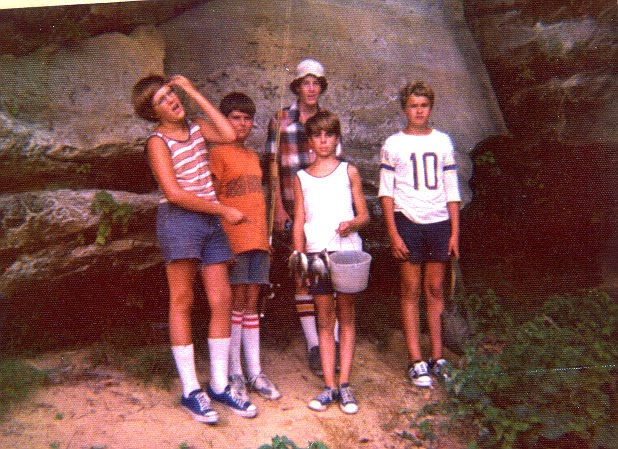 |
| Small crappie and bluegill caught from limestone ledge high above the water. |
Through the years there were variations on the theme. There was the early period of cane pole fishing, fishing for bluegill at a nearby pond, cat fishing with stink bait, unsuccessfully attempting to catch crappie with jigs, a cold and equally unsuccessful attempt at ice fishing, fishing from high above the lake on a limestone ledge, and trying for largemouth bass with lures. My bass fishing period was short-lived but eventful. On my very first day of trying for a largemouth, I had hoped to use a frog lure that was in my brother’s boat. He didn’t want me to disturb his own fishing, so he tossed the rubber frog lure to me, missing my boat and sending the lure slowly drifting to the bottom of the lake. He then fished around in the tackle box, found a Hula Popper and tossed that to me successfully. I tied it onto my line and started casting at some willows, slowly popping the lure back to the boat. On about the third cast, there was a loud splash as a huge lunker rose to hit the lure, and I immediately set the hook. It was putting up an incredible fight, and my brother, who earlier had not wanted me near, suddenly took an interest in the battle. As he paddled his boat which contained the fish net towards mine, he coached me on how to slowly ease the fish to my boat. At one point the bass jumped free of the water, impressing us both with its size. But just as my brother arrived, the line snapped and my trophy fish was gone! I was heartbroken but now more determined than ever. That afternoon I went to Ebert’s, the small family run fishing/grocery store that supplied the camp with all its needs, and purchased a new Hula Popper. Early the next morning, I was back at the clump of willows casting out my line, when suddenly a large bass jumped in front of me. I looked at the growing rings of concentric circles marking the spot of the splash, and there floating on the water, where the fish had just jumped, was the lure I had lost the previous day. Could it be that the bass I had hooked just 24 hours earlier had reappeared to spit out my lure and mock me? It seemed like a fishy version of “Fool me once, shame on you. Fool me twice, shame on me.” I retrieved my “lucky lure,” but never again was I able to hook a largemouth.
 | ||
| My lucky Hula Popper |
The memories drift away as Bing and Satchmo are winding down the song, the pond well behind me in the distance. It is emblematic of my fishing experiences since they, too, are well behind me. It has been 30 years since I’ve seriously fished. How I miss those quiet days on the water and the mornings and evenings spent with my parents. I would love to cast a line back in time, hook those days and pull them back to me, but that is just another one that got away.