Sunday, March 13, 2011

The Lake

I am a city boy, born and bred, yet nothing held sway over my formative years more than my time at “the lake.”  The lake in question was Raccoon Lake, a large reservoir in west central Indiana, and the label of “the lake” referred to not only the body of water but also the woods surrounding it and the trailer park that we called our home away from home for over two decades.  Every weekend from early spring to late fall, every spring vacation and a few long stretches in the summer were spent either on the water or traipsing through the woods.  Millionaires may boast of “weekends at the Hamptoms,” but I can assure you none was every happier than I was with my weekends at the lake.

Grandma Bess, Dad, Uncle Earl, Grandpa Jesse and my cousin, Maggie enjoying a game of cards
I was first introduced to the lake when I was about five years old.  Often on Sundays my parents would pack us into the station wagon with a picnic lunch and fishing poles, and we’d go to a reservoir near Indianapolis to fish.  But that fateful weekend was different.  We left early in the morning and drove for nearly two hours before we turned off the highway and started winding through gravel covered country roads.  That in itself was new to me and only added to the excitement of what was to come.  After an endless number of turns and twists, we came to a small country store run by the family who lived in the back half of the building.  While my father bought bait for the day’s fishing, my siblings and I eyed a wall that was nothing but candy, all at the grand cost of a penny a piece.  Sure, there were a few expensive items for 15 cents, but the majority was to be had for a single penny.  My father gave us each a dime, and the decision was almost overwhelming.  I can appreciate how someone who has just won the lottery must feel because at that moment I felt every bit as rich.   With our little brown paper bags full of assorted gum, paraffin pop bottles and licorice, we climbed back into the car and headed to our final destination.

Our first trailer.  My Aunt June, my brother Jerry, me, Dad and my sister, Sheila
I can still recall how magical it seemed as we drove through the heavily wooded road and past a pair of small ponds before emerging at the trailer camp.  I had never seen mobile homes before, and I was certainly not aware of the stigma that goes with most trailer parks now.  Rather than being dismayed by these small, flimsy living quarters, I was enthralled by the myriad of shapes, sizes and colors.  Each trailer had its own little gravel lot with an outdoor fireplace and those classic metal lawn chairs of the 50’s and 60’s.  Surrounding each parcel were strings of lights hung like Chinese lanterns.  To me it looked like Christmas in the middle of summer.  As we slowly made our way down the hill that held the camp, my siblings read some of the signs people had hung on their trailers.  There was a mailbox mounted high on a pole with the words “Air Mail” painted on its side.  Next to this was a trailer named Malfunction Junction.  It was a totally foreign and mysterious world, but one I knew I would love.

Nick frying fish
Our destination was a very small trailer with a large attached porch enclosed in heavy plastic.  It belonged to the father of one of my dad’s postal employees.  Nick, who had long since retired from his years of living, working (and drinking) in the big city to settle for a quieter, sober life in the woods, was the sole permanent resident of the camp.  A short, bow-legged man with a bur haircut, Nick came walking out to greet us.  He invited us to the back of his property on the other side of the porch where a fire was crackling in a fireplace and his coonhound, Queenie rested.  Her belly was large, her breasts were filling with milk, and I was allowed to rest my hand on her stomach to feel the wiggling puppies within.  A widower, Nick’s sole companion throughout his years at the lake was always a dog.   Nick, his son, Jim, and Pete who owned the trailer next door, were gathered around a table nailed to a tree along the ravine that ran behind his property.  They were all busy cleaning fish from that morning’s catch.  After scaling each fish, they would pick up a knife and deftly fillet it before tossing the remains in a hole dug behind the tree in the woods.  It was a routine I would see repeated over and over again for years to come.  I suspect the soil behind that tree had to be some of the richest in the state given the years of fish deposited there.

My brother Jerry and I showing off our catch
Fishing was the main pastime during our years at the lake.  That day would to be our first experience, with Nick loaning us one of his boats.  In those days, the lake was quiet and the only boats you saw were either row boats, flat-bottomed John boats or the occasional pontoon.  I was still using a cane pole to fish in those days, but it didn’t lessen the fun.  I don’t recall if we caught anything, but I do know as the day wound down Dad walked across the road to talk to the family in the blue trailer.  What I did not know was that my parents were actually in discussion to buy that trailer, but  I soon learned that this magical camp would become our weekly destination, and that little blue trailer was to be the first of three trailers we were to own there.

My weekdays may have been filled with bike riding, swinging or shooting baskets in the backyard, but from the 1960’s through the early ‘80’s, my weekends were spent boating, fishing, hiking, and learning the flora and fauna surrounding our camp.  The woods became my classroom, and I began a lifelong love of nature.  In fact, I am sure that early fondness of nature and animals led to my current profession as a veterinarian.  In the 60’s, the woods around our trailer was still unspoiled.  Insect life was abundant and varied.  My sister and I would frequently return from a hike with a collection of colorful caterpillars or perhaps a large walking stick that looked more like it belonged in the Amazon than an Indiana forest.  I became adept at identifying the various wildflowers that bloomed in the spring, and I eventually created my own little wildflower garden on the edge of our lot which I suspect still blooms even now.  Thus was born my love of gardening.
My sister-in-law, Debbie, Mom, Dad and me

Our neighbor Ginny eating fish with Mom
In the Midwest, we are blessed with four very distinct and glorious seasons, and my time at the lake taught me to appreciate the unique qualities of each.  We would anxiously await the spring thaw that would signal our return each year.  At the first sign of warmth, Nick would tap the maple trees.  He would boil the sap to make sassafras tea which we drank as our “spring tonic.”  A little later, as the soil warmed more, the sponge mushrooms would make their appearance.  We were fortunate in that the morels would spring up in our very lot, although I enjoyed searching for them in the woods.  Raccoon Lake was used as flood control for the Wabash, so each spring its waters were retained, and the lake level would rise into the grove of silver maples and willows that grew on the opposite point.  Dad would nose our boat in amongst the trees, and we would fish for the spawning crappie through their branches.  Summer slowed things down and I would fish for carp from the bank.  Using a dough ball made from Wheaties and garlic powder, I would sit and watch for the telltale bob of the slack fishing line.  It would suddenly grow taut, then relax, then grow taut again before racing out across the water’s surface.  That’s when I knew the fight was on, for although carp was not a fish we ate, it was the most fun to catch since it put up the biggest fight.  For a small boy it was the equivalent of deep sea fishing.  For bluegills, I would dig up worms, grab my pole and walk to the small pond that sat beside the road into the camp.  Here the fish were not big, but they were hungry, and an active day of fishing was guaranteed.  In my high school years the summer meant early morning water skiing.  By then the lake had grown busy, and only in the mornings could I enjoy a smooth surface.  Autumn brought with it the changing of the foliage, and the ever present smell of burning leaves.  
An early morning ski run

Cooking sausage and potatoes over the fire
For me the most powerful memories are evoked every time I smell wood smoke or burning leaves.  I’m instantly transported back to those days at the lake when we always had a fire burning in the outside fireplace.  Our camp was somewhat primitive with only electricity provided to the trailers.  We hauled water from the few spigots in camp and answered the call of nature in an outhouse.  (The smell of an outhouse in August is a memory I would rather forget.)  We did have propane tanks to fuel our furnace in the trailer, but the fire was our source of outside warmth during the coldest days.  Many times we melted the tips of our shoes as we pushed our feet closer and closer to the flames to heat them.  Water for bathing or washing dishes was heated in a big black coffee pot, and of course all meals were cooked over an open fire.  Nothing has ever tasted better than those meals.  I can still picture my dad relaxing by the fire in the falling snow, beer in hand, watching supper cook on the fireplace.   Even as a young boy, I was allowed to make my own little fireplace over which I heated the smaller kettle of water to make hot tea.  I felt like a true pioneer. And it was during those years that I got my earliest experience with physical labor, helping Dad collect and cut firewood.  There were enough dead or downed trees to supply a steady source, but you had to make the effort to collect it.

Winter was the season we stayed home.  The owner turned off the water and chained the entrance to the camp; however, on a few adventurous occasions, we decided to brave the elements and make a visit.  Dad would drive as close as possible then park the car, unload our supplies on a sled and we would pull them down the hill to the trailer.  This was one of my favorite times to visit because we had the whole place to ourselves.  The snow stood deep and untouched on the tables and fences, and the camp was silent except for the calling of woodpeckers.  I would quickly head off into the woods to track the animals who had ventured near the abandoned camp, and Dad would start a fire in the pot-bellied stove we used to warm the porch.  One winter he managed to get it so hot it cracked the nearby window.  I still promise to someday relate the story of Dad’s sledding adventure during one of those winter trips, but that is a story for another day.

My friends Dan, Maris, Jim (in rear behind me) and Paul
Finally, the lake was the one place I seemed to fit in.  At home in the city, I was an awkward child with few friends.  A klutz at sports, I was shunned from joining teams and would sometimes be offered up to the other side in advance.  But at the lake, I was in my element.  I was small, light and exceptionally agile in the woods.  It was the one place I could outshine even the most athletic of my friends, but it was rare I was there with a friend.  I relished the solitude of the woods.  Whether napping on a wooded hillside or floating quietly on an inner tube, I was alone with my thoughts.  I learned to be independent, and it was there I plotted my future.  Even now when pressures become too great, I slip outside and smell the fresh air, follow the creek or listen to the birds.  Like Ishmael in Moby Dick, “It is a way I have of driving off the spleen and regulating the circulation.”
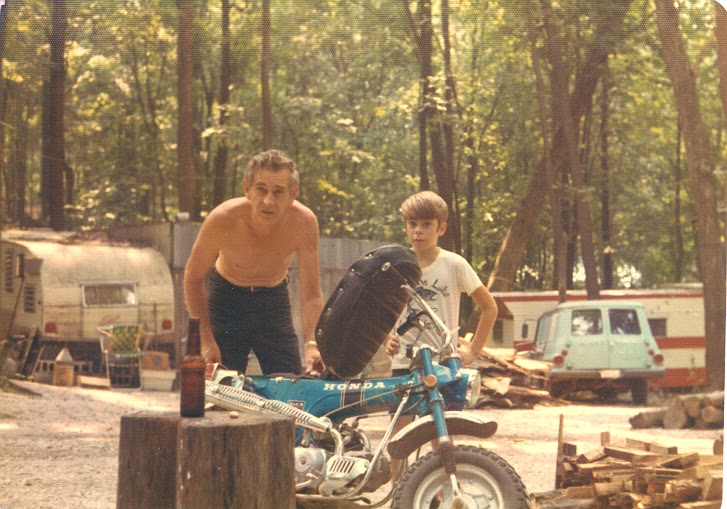
Dad working on the Honda.  Nick's little trailer is in the background.
There are many stories I could tell of the lake- nights on the water when the Milky Way painted its cloudy path across the sky, the fall that broke my mother’s leg and began her physical decline, the loss of a precious puppy, the death of a dear family friend, lightning strikes, fossil hunting, the sinking of my sister's raft, adventures on a minibike, and sadly the change from a quiet lake and empty woods into an active and dangerous waterway with a diminished woodland encroached upon by houses.  But those remain stories for the future.  For now, I want to just sit back and reflect upon those glorious early days when I was introduced to the natural world around me and began a lifelong love affair.

Sunday, March 6, 2011

A Look Out My Window

Today has dawned gray and cold.  Sunshine has been in rare supply lately, but at least yesterday’s rains have moved on.  We received about two inches of rain which once again left the wooded part of my front yard standing submerged.   Thankfully, my hellebores again have their heads above water.  They are one of my stronger plants, sending up blooms well before any other flowers and yearly withstanding these spring floods.  I like them, too, because the deer do not.  My rhododendron cannot make the same claim.  The long period of deep snow and ice this winter limited the food supply.  Large herds of deer began to appear, and apparently on the menu was every leaf and bud of my rhodie.  Its burgundy blooms will be sadly missed this year
.
As I write, I’m looking out the window of my library, and I can see that the pond behind my property is once again within its banks.  Whenever we have a heavy rain, the creek and pond merge into one large body of water.  I suspect the water was three feet higher yesterday, making the small cabin on the far side a wooden island.  The ducks are happy though, and I can see the mallards coursing back and forth across the pond’s surface.  The Canada geese are conspicuously absent today, but I’m sure before day’s end, they will also make an appearance.

Earlier, I saw some very large, black birds rise and soar across the pond.  I pulled out my binoculars and saw that they were my first turkey vultures of the year.  Apparently some small, unfortunate creature did not survive the winter, and the vultures were huddled around for breakfast.  Speaking of breakfast, I have not made it out to feed the birds yet.  A flicker is working on the last few seeds in the tube feeder.  It is quite a balancing act for him to hang onto the lowest perch and swing his long body back far enough to allow him to reach the seed port.  The ever present squirrels are busy cleaning up all the fallen seed from the ground.  Last night I forgot to bring in the suet feeder that hangs on the deck, so I see the raccoons ate well.

This is still the sparse time of year, as far as birds are concerned.  My yard is full of the usual winter suspects- cardinals, titmice, nuthatches, chickadees, as well as assorted woodpeckers and sparrows.  My first eastern towhee (I still prefer the name rufous-sided towhee) appeared a few days ago.   I think I failed to see one last year, nor did I hear its call to “drink your tea.”  I have heard owls calling, though, as they lay claim to their breeding grounds.  They get a head start on all the other birds.  I miss the barred owls that used to nest in the old beech tree out back.  Each evening the male would fly in and call to his mate.  She would leave the nest and sit next to him on a branch, and they would nuzzle for a while before flying across the creek to hunt around the pond.  A few years ago I watched them do that very act.  I watched as they disappeared into the dusk.  That night I heard gunshots from across the creek, and I never saw the owls again.  I did however hear their chick cry in hunger for two or three days, sitting weakly in the nest opening until one cold and rainy day, it too was silenced.  The next year the tree toppled in a storm, and although I hear owls in the area, they have not returned to the trees near me.  

Life is hard for these animals.  Last year we had a pair of foxes who had nested nearby.  Most days they could be seen sunning themselves beneath the dogwood in the back.  But as the summer wore on, I noticed their hair thinning in patches and the foxes becoming itchy.  After a while only one fox was even visiting, and its mange had reduced it to a naked, scaled monster.  It looked weak and miserable.  The neighbor across the street tried to help by tossing out chicken livers, and it did hang on for a long time.  Eventually, even this solitary survivor disappeared, as well.   I don’t like to think about this part of nature, but it happens.  I prefer to await the rebirth that is coming.  Soon the spring peepers will start calling, the woodland ephemerals will rise up and bloom in all their glory, the woods will take on that green haze that signifies the trees are starting to break bud, and the warblers will arrive from their South American winter holiday.  I suspect we’ll see a fawn or two accompany their mother into the backyard, and if we’re lucky, maybe a new fox will stake claim to our little piece of the world.  I don’t know what the year will hold, but I do know I am ready for it.

Tuesday, March 1, 2011

Tagged

A picture came into my life the other day.  It arrived in a Facebook post with the announcement that I had been “tagged.”  Being the curious sort, and admittedly a little bit vain, I immediately clicked on the link, and there before me was a snapshot of my life taken over 40 years ago.  I had never seen this photo, but it instantly transported me back to that early Sunday morning back in 1966 or ’67.
The picture is a slightly blurry, black and white photo showing a young boy and girl linked arm in arm wearing their Sunday finest.  The occasion was Easter morning, and the young couple was myself and next door neighbor, Julie Walker.  Julie and I were the same age, only four or five years old, when this picture was taken.  We had been born into this neighborhood and were the only ones of our age, so it was natural that we became early playmates.  It was only a couple weeks ago that I had written to Julie that she was the first friend I ever had, and that is true.
Julie and I did everything together in those early days.  In the summertime; we played together, either swinging on my swing set trying to touch the overhead electrical lines with our feet (obviously an impossible prospect, but it was a goal we still fought to attain) or maybe to even swing high enough to loop over the top, which for us was another equally impossible goal.  I’m sure many important childhood discussions were held on those swings, as we swayed back and forth and contemplated life from a five year old’s perspective.  Sometimes we played in Julie’s backyard, cramming our little bodies into her dog, Tippy’s doghouse.  I still don’t know how we managed to fit both of ourselves into that cramped, smelly space, but we did.  We might sit out on the front porch and have a popsicle together, or perhaps help Mom snap green beans for dinner.  We attended school together until I transferred to school 89 in fifth grade, not rejoining her until our high school years.  We also attended the same church, and that is where we were headed when this photo was taken.
The setting for the picture is the street in front of my childhood home.  We’re standing at the end of my gravel drive.  The photographer is standing under “the big tree.”  That is how the tall cottonwood at the back corner of Julie’s yard was known to the kids in the neighborhood.  It was the common meeting place and provided a cool pool of shade on a hot summer’s day.  There was always someone sitting under or perched high up in that tree.  The large spruce trees in the far neighbor’s yard are no longer there, but the little maple tree in my front yard is now a grand specimen.  The driveway was gravel for nearly all the years I lived there, but once I moved out, my parents had it paved.  I remember getting the job of sweeping the gravel off the walk or out of the street, and in the winter, one had to be careful to shovel snow and not scoop up too many rocks. 
The car in the background is my family’s car, and the first car I was to ever know.  I believe it is a ’56 Buick special and was white over light green.  My memory always paints that car a dark green or black, but pictures don’t lie.  I can remember our having the Buick, but for some reason, I don’t remember riding in it except for one time.  My father was giving my sister, Sheila a driving lesson.  Sheila had never driven anything, let alone a car with a clutch.  So that afternoon my sister managed to jump, hop and stall that car over and over again all the way down the street.  I was along for the wild bronco ride, and I think that is why that particular day still holds a spot in the dusty corner of my memory.  I don’t know if Sheila ever did master the Buick, but my oldest sister lists it as having been one of her favorite cars to drive.
In the photo, Julie and I are dressed for Easter services.  Those were the days when people still shopped for a special outfit to wear to church on Easter morning.  Today you are just as likely to see someone go to Sunday church services in blue jeans and a sweatshirt.  I miss the days of women with gloves and pillbox hats with their short veils and men in suits and hats.  I always looked forward to Mom buying me my new spring suit.  It always made me feel older and more important.  Julie is in her Easter dress with her anklets and gloves and patent leather shoes.  Her father had coated them the night before with Vaseline to accentuate the shine.  Her little grown-up purse is hanging from her wrist.  We were quite the couple.
I have a vague recollection of being told to hold her hand for the picture and not being particularly happy about it,  The sad face in the shot would seem to bear this out.  It wasn’t that I didn’t want to pose with Julie, but at that age, such public displays of affection were anathema to me.  But pose we did, and now four decades later I sit and look back on those happy times longingly. I want to go back to when tag was a game Julie and I played in the backyard and not a Facebook term.  Thank you Julie for sending me the photo, and thank you for being such a good friend all those many years ago. 

Friday, February 25, 2011

A Slippery Slope


The backyard this morning
It has happened again; winter has dug her icy talons into my life.  I awoke this morning to yet another fresh coating of snow.  It was only a week ago that I saw the ground again for the first time in nearly a month. I must admit, the artistry was magnificent.  It was hard to see just how beautiful it looked at first since I was up before dawn to shovel the walks at work.  However, as the sun rose and burned its way through the clouds, a true winter wonderland was revealed.  It was one of those wet snows that clings to each branch and twig and paints the tree trunks white.  Such storms are like shooting stars - shining brightly for a brief moment but destined to fade quickly away.  By noon, the temperature had already climbed above freezing, and the warmth of the sun caused the snow to lose its grip and begin tumbling in wet plops to the ground. In a couple days, the temperatures will once again climb into the 50’s and the snow will vanish just as quickly as it appeared. 

I have tired of shoveling snow and ice this winter.  It has felt like a never ending assault, and my nerves have finally cracked under the pressure.  But that is not to say that I don’t like snow; quite the contrary.  I have always loved snow, from my earliest memories of standing patiently as Mom dressed me in layers, pulling on my coat, struggling to get my wiggly fingers stuffed into gloves, and tugging on my boots, right up to recent years where a steady snow falling on a still night beckons me out into the darkness to go for a walk. 

I love those quiet times where the only sounds are the crunch of my boots and the soft tapping of heavy flakes against my face and hat. But for sheer joy in the snow, I have to go back to pre-shoveling days.  In those early years, snow always held the promise of a day off school, although attending Indianapolis Public Schools meant that was a rare event.  For me snow was not measured by how much there was to remove, but by how easily it packed to make a snowman or a fort.  I can remember after a particularly heavy snow, hollowing out the pile pushed to the side of my neighbor’s drive, sliding in and watching my clothes steam in the warmth. Likewise, I recall how the bottom half of my jeans would always freeze, being stiff and frosted to the knees whenever I had been out playing.

I was not privileged to be born in a mountainous region.  Mid-westerners must travel long distances to ski, but we are well versed in sledding.  When you are young any hill will do.  In my first neighborhood, the properties on my side of the street were flat, but the neighbors on the opposite side lived on a gentle rise.  The goal was to find a neighbor who was not yet home from work and who had not cleared their drive, then you would hurry down and get in some quick sledding runs, making sure you didn’t shoot out into the street when a car was passing by.  Thankfully,  it was a dead end street, so cars were rare.

If you wanted to get a real thrill, you had to talk your mom or dad into packing you into the car and heading to one of the hot spots nearby.  For us there were three potential sites- the local golf course, the hill behind School 77, or Ellenburger Park.  Ellenburger was by far my favorite with the tallest, steepest hill of all three.  It meant a little more work climbing to the top, but the trip down was reward enough.  There were three different paths you could take down the hill.  There was the straight forward, regular hill.  It was long and fast and was the most used part of the park.  Just to the side of this was an area where the ground formed a series of steps that were to a sledder what moguls are to a skier.  I fancied myself a highly skilled sledder, so this was my preferred route.  On the regular hill, I would traverse the course in the age old, belly down position.  For fun, we might stack two or three of us together, but invariably, the stack would lean, and we would all tumble halfway down.  But I had mastered the ability to stand on my sled and ride it like a surfboard, and that is how I would traverse my stepped course.  I’ve never been given to much confidence or cockiness, but I’ll admit, after riding this difficult stretch, I sort of looked down my nose at all the little kids struggling with their saucers on the big hill.  

Eventually, I began to imagine myself as some sort of alpine rescue worker, ready at a moment’s notice to hop on my board and save some poor unfortunate soul. One day I got just that chance.  This time the sledding was occurring on the third area of Ellenburger.  A little past the bumpy hill was the path that wound through the pine trees.  It was a little less steep, didn’t include the bumps but required turning, which limited its use.  With a Flexible Flyer and a little skill, one could easily traverse the path between the trees, but all the poor unfortunate kids with discs and toboggans were forever stuck on the big, open hill.  On this particular morning, I noticed a mother encouraging her young son to go down the wooded path.  I was frustrated because they were blocking “my path” so I sat back and watched and waited.  The boy was obviously very nervous about making the run, and he tearfully argued with his mother.  But she held firm and eventually was able to convince him to give it a try.  Reluctantly, he climbed aboard his sled and with a soft push from his mom, began his trip down.  I was waiting for him to hit a tree, but he surprised me and managed to make the turns and remained squarely on the path.  What neither he nor his mom had taken into account, however, was the fact that at the bottom of the hill were all the discarded Christmas trees from the neighborhood, piled high for the upcoming bonfire for the 12th Night ceremonies. As the giant brush pile grew ever closer, the boy held his course and kept a firm grip on the sled.  I thought he would roll off or find some other way of stopping, but he just kept charging forward.  In amazement, I watched as he rammed full speed into the stack of trees, half his body disappearing into the pile.  He was stuck and immediately started calling for help.  Ah, my moment of glory had arrived.  I grabbed my sled, took a running start and dove down the hill holding the sled tight to my body.  I hit the ground with a breath jarring thud, but I already had good speed.  I angled across the hill towards the trapped boy, and just as I approached the trees, I rolled off allowing my sled to continue. I jumped to my feet and charged over to free the crying boy from his entrapment.  It wasn’t difficult, I only had to lift one or two trees before he and his sled were free, but it didn’t take anything away from the pride I felt in performing my first rescue.  I waited a moment or two for the thanks and praise that would surely be heaped upon me by the mother, but instead she just tip-toed her way down the hill and began another verbal assault on her son for not having avoided the tree pile.  It was as if I didn’t exist, so quietly I picked up the rope to my sled and plodded slowly away, my skills and heroism unacknowledged.

As I grew, so did my center of gravity and soon the surfboard style of sledding gave way to more traditional approaches.  Eventually, sledding stopped altogether for me until one night in high school when a few of my buddies invited me to join them for a late night sledding adventure. Our destination was a steep hill in the woods.  Sledding through trees is actually a very foolish proposition, even in the daytime, but teenagers have not yet developed that part of the brain that registers fear or common sense.  (You can trust me on this, I’m a doctor!)  So one by one we headed off through the trees.  It wasn’t long before the crashes started.  Shoulders, heads, and fingers soon bore the marks of unexpected meetings with tree trunks.  I believe my friend Steve broke a finger and we questioned whether one of the other guys had hurt his collarbone.  After my first impact, I learned my lesson.  When I suspected I could not make the turn to avoid a tree I would simply roll off.  The sled would still hit the tree squarely, but I would at least be safe.  This plan worked fine until my coat snagged on a nail sticking out of the sled’s surface.  Instead of rolling off, I sort of pivoted around the nail and was turned perpendicular to the sled, yet still on it.  The tree hit me squarely in the stomach, and I swear my head and knees met on the other side of the trunk.  The wind was knocked out of me, as well as the rest of my bravado.  We called it quits for the night, and with the exception of one glorious weekend of sledding at our trailer at Raccoon Lake (that’s a story for another day,) I ended my sledding career.

Sledding with my son many years ago.
These days I pick my steps carefully on the snow.  I’ve taken more than a few tumbles this winter.  The old Flexible Flyer sat rusting in my parent’s basement for many years.  I don’t know what happened to it.  Perhaps my sister inherited it for her girls.  I limit myself to driving by our local sledding hills and watch the young ones having fun.  It is their time now, but there was once a time where I truly felt I was king of the hill.


Tuesday, February 22, 2011

The Newlyweds


Bess and Jesse Fifer 1917
It’s a prized photo.  A young couple stands in the shade of a tree in the yard of an Illinois farm.  She has her arm lovingly thrown around her partner’s shoulders.  With his hat clasped in his hand, he is dressed in his nicer clothes and not the overalls he usually wore on the farm.  Her bobbed hair and manner of dress suggests the time period is the 1920’s, but I know it is even a little earlier than that.  In fact the year was 1917.  The couple was newlyweds, and they were deeply in love.  The pride of their new-born life together and the hope and promise of their future was very evident on their faces.  Their names were Bess and Jesse Fifer, and they were my grandparents. 

They had reason to be proud of this marriage.  It hadn’t come easy.  After the usual courting period, Jess finally worked up the nerve to propose.  They went for a ride in the buggy and when the time was right, they stopped; Jess got down on his knees and “prayed” that Bess would marry him.  She played coy at first and said no, but finally she acquiesced and said yes.  According to Bess he was so startled by her reply that he fell out of the buggy, startled the horses and sent them running.  Bess quickly reined them in and brought the buggy back to see Jesse on his knees and rubbing his head.  He looked up and said, “Did you say yes or no?”  She assured him that her answer was indeed yes.

There is no wedding photo of the couple, however.  That is because there was never a traditional wedding.  Because Bess was not yet 18, the couple was not allowed to be married.  That did not stop these two love birds.  On a cold, cold day in February, 1917, Bess climbed out of the window of the home where she and her sister were staying, and she and Jesse eloped.  They were to be instantly tested.  February of 1917 was the ninth coldest February ever recorded in Illinois.  On the day they eloped, even Georgia and Florida did not climb out of the 20’s.  In central Illinois, the temps were subzero.  Family legend has it that even the trains were not running that day due to the severity of the weather.  Nonetheless, the young couple climbed into their buggy and began a 40 mile trip over frozen muddy roads from Arthur to Sullivan, Illinois.  It must have been brutal, but their love for each other and the excitement of the moment kept them warm.

Finally, they arrived in Sullivan and still had one more obstacle to overcome, Grandma’s age.  No problem.  Bess was not going to be put off by the fact that she was still a few months shy of her 18th birthday.  As she explained it, “I wrote down the number 18 on a piece of paper and put it in my shoe.  When the judge asked me if I was over 18, I said yes.  And I was…I was standing right over it.”  Problem solved. 

That hand is still on his shoulder more than 60 yrs later
And that is why the two people in the photo look so happy.  They had conquered the weather and they had conquered the law to start on what would be a 67 year love affair.  It was a life tested by two world wars and the Great Depression, but their love carried them through.  In 1983, just a week shy of their 67th anniversary, Jesse suddenly died.  Grandma Bess, who had always been so full of life and playfulness, became just a shadow of herself.  Although she would fight back, she never fully returned to that carefree person I see in the picture.  What carried her along the next five years was the belief that they were still together in spirit.  Grandma would often disappear into her bedroom, and we could hear her talking to Grandpa.  Love never really dies.  That’s why I’m sure that on that morning in March of 1988, when sipping her morning coffee at the breakfast table Grandma collapsed and passed, there was a scene in heaven much like the old photo.  A couple was again snuggling together, their arms wrapped around each other, and their faces once again illuminated by those big, beautiful smiles.  Yes, love never dies.